Minimum ID needed for a Nationally Coordinated Criminal History Check
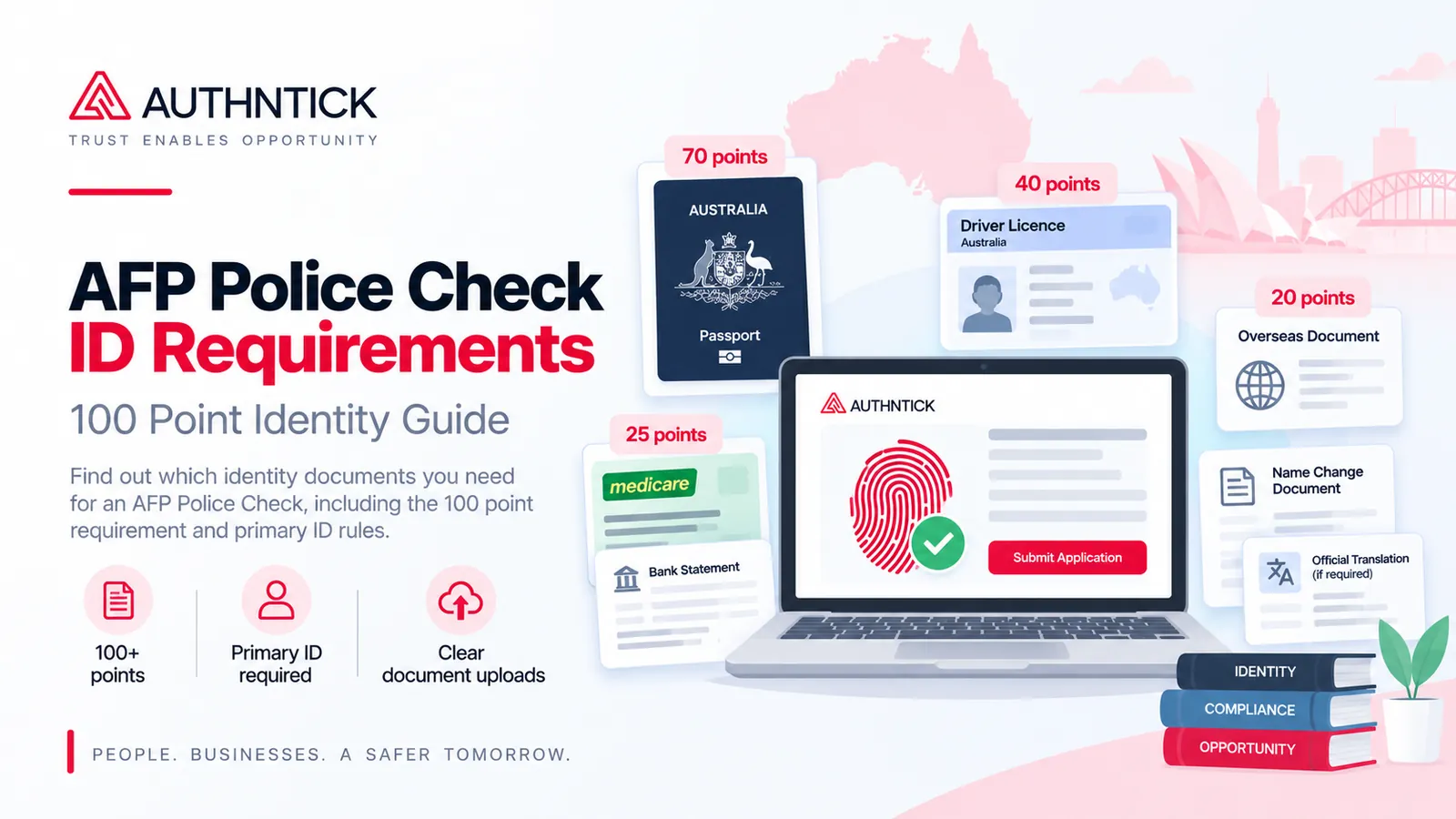
This guide explains Nationally Coordinated Criminal History Check identity documents, 100 points ID concepts and background verification ID. If you are still comparing check types, read the Nationally Coordinated Criminal History Check guide first.
Identity Document Requirements for a Nationally Coordinated Criminal History Check
When applying for a nationally coordinated criminal history check (NCCHC) through AuthNTick Identity Services, you must provide identity documents to confirm who you are. This helps protect your personal information, supports accurate identity verification, and ensures compliance with government verification standards.
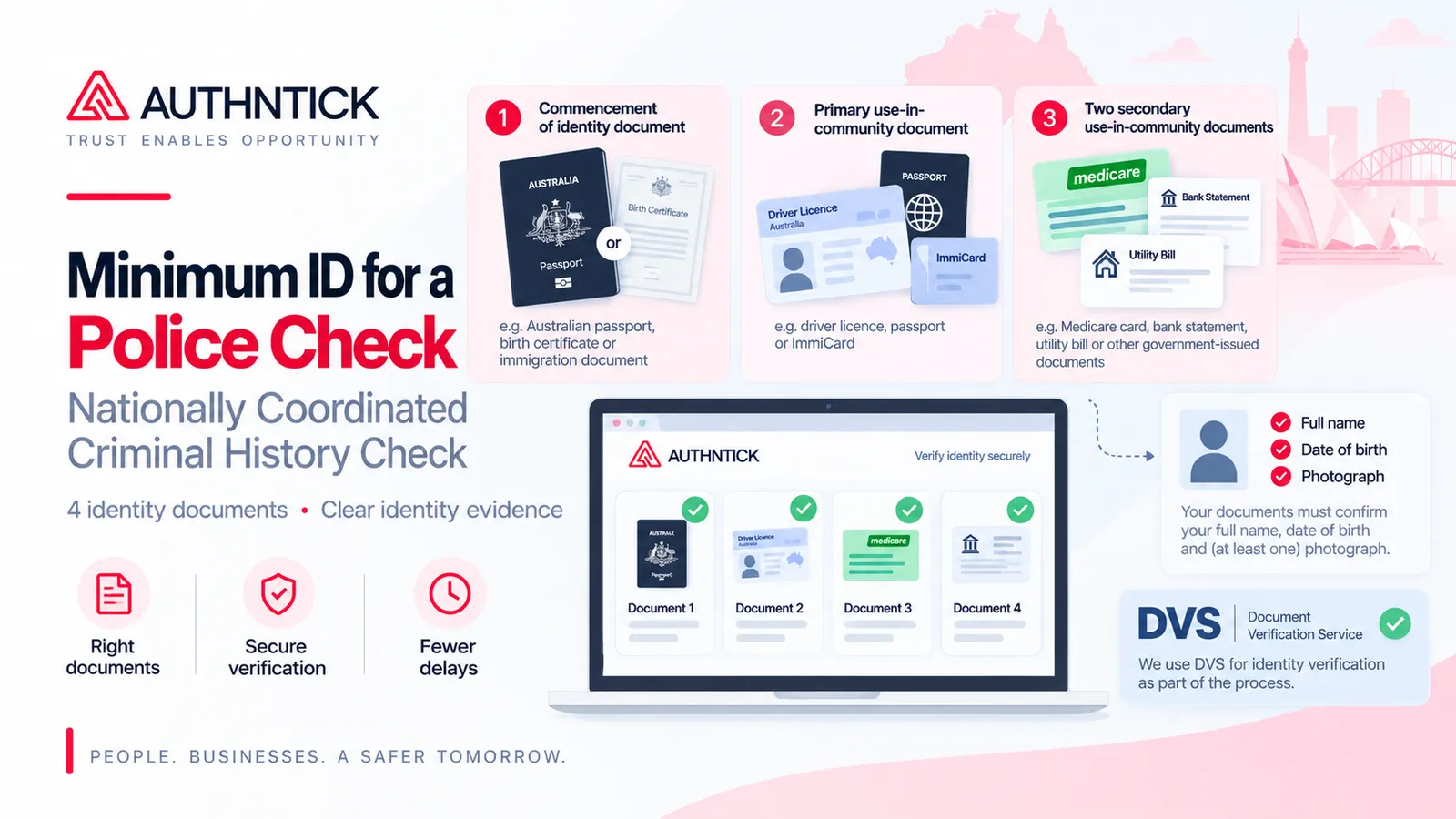
To complete your Nationally Coordinated Criminal History Check application, you need to provide four identity documents: one commencement document, one primary document, and two secondary documents. These documents help verify your full name, date of birth, and photograph so your application can be processed securely and efficiently.
Ready to Apply for a Nationally Coordinated Criminal History Check?
Start your Nationally Coordinated Criminal History Check application online today. Before you begin, make sure you have the required identity documents ready.
Nationally Coordinated Criminal History Check Identity Document Requirements
You must provide four documents with your completed application:
- One commencement document to confirm your birth in Australia or your arrival in Australia
- One primary document
- Two secondary documents to show the use of your identity in the community
AuthNTick Identity Services uses these documents to verify your identity against the personal information you provide online or through a downloadable form. By creating an account with DPI Consulting, you consent to the use of your personal information for the purpose of conducting a nationally coordinated criminal history check.
Your documents must include evidence of your full name, date of birth, and photograph.
Note: Your commencement and primary documents must include a photograph. If either document does not contain a photograph, you must also submit a passport-style photograph certified by a person listed in Schedule 2 of the Statutory Declarations Regulations 1993 (Cth).
Provide One Commencement of Identity Document
- Australian Birth Certificate or authorised record of birth (not an extract or birth card)
- Immigration record or document, including an Australian Citizenship Certificate
- Australian visa supported by a foreign passport, current at the time of entry into Australia
as a resident or tourist
This may be verified through the Visa Entitlement Verification Online (VEVO) system. - ImmiCard issued by the Department of Home Affairs
- Current Australian Passport (not expired, or up to 2 years expired if verified using the Document Verification System)
Provide One Primary Use in Community Document
- Australian passport (Ordinary, Frequent Traveller, Diplomatic, Official or Emergency)
- Australian driver's licence, learner permit or provisional licence issued by a State or Territory
- ImmiCard issued by the Department of Home Affairs
- Foreign passport with a valid Australian visa or valid entry stamp
- Proof of age card or photo identity card issued by an Australian government agency
- For persons under 18, a student identity document issued by an Australian government agency or school
Provide Two Secondary Use in Community Documents
- DFAT issued Certificate of Identity
- DFAT issued Document of Identity
- DFAT issued United Nations Convention Travel Document
- Foreign government issued documents (non-English documents must include a NAATI-accredited translation)
- Medicare card
- Australian Electoral Commission enrolment
- Security guard or crowd control photo licence
- Evidence of entitlement to a government benefit such as Centrelink or DVA
- Consular photo identity card issued by DFAT
- Police Force Officer photo identity card
- Australian Defence Force photo identity card
- Commonwealth or State/Territory government photo identity card, including Working with Children or Vulnerable People cards
- Aviation Security Identification Card
- Maritime Security Identification Card
- Firearms licence
- Credit reference check
- Australian secondary or tertiary student photo identity card
- Certified academic transcript from an Australian university
- Trusted referee report
- Bank card
- Credit card
- Tax File Number
Need Help With Your Nationally Coordinated Criminal History Check Documents?
If you are unsure which identity documents to provide for your Nationally Coordinated Criminal History Check, contact our team before submitting your application. We can help you understand which documents are accepted and whether additional certification is required.
Helping you verify your TFN
We want to make verifying your identity as easy as possible. If you choose to provide your Tax File Number (TFN) as a secondary document, it should be supported by an official record that links the TFN to you personally.
What we can accept:
Any official correspondence from the Australian Taxation Office (ATO) that
shows your name and residential address. Most customers find
it easiest to provide:
- A Notice of Assessment
- A TFN confirmation letter
Update to Expired Australian Passports and DVS
Recent guidance indicates that some expired Australian passports may still be capable of being verified through the Document Verification Service (DVS) after expiry.
If you plan to use an expired Australian passport as part of your identity documents, please make sure it meets the current DVS acceptance requirements at the time of application. If you are unsure whether your expired passport can be accepted, contact our team before submitting your Nationally Coordinated Criminal History Check.
If you have any questions about TFN documents, expired passports, or any other identity requirements, please contact our support team before submitting your application.
Apply for Nationally Coordinated Criminal History Check Today
Digital Birth Certificates now available in NSW
NSW Digital Birth Certificates are now available to eligible people aged 16 to 21 who were born or adopted in NSW. The certificate can be accessed through the latest version of the Service NSW app. To apply, a person must have their birth registered with the NSW Registry of Births, Deaths & Marriages and must hold a NSW Photo Card or NSW Driver Licence.
The Digital Birth Certificate is optional and does not replace the paper version. It shows the same information as a paper birth certificate and is available at no additional cost during the first release.
For businesses and organisations, NSW Government guidance confirms that a Digital Birth Certificate has the same legal standing as a physical paper certificate under section 20 of the Births, Deaths and Marriages Registration Regulation 2025. It can also be verified using document verification services in the same way as a physical birth certificate.
Where a birth certificate is accepted as a Commencement of Identity document under an Access Agreement, organisations should treat a NSW Digital Birth Certificate in line with their existing identity-proofing procedures, relevant agreement requirements, and internal policies.
Helpful NCCHC Guides
Use these related guides to understand the right Nationally Coordinated Criminal History Check pathway for your situation, whether you are applying for employment, volunteering, identity support, processing time, probity or special background screening.
Pre-Employment Screening Guide for Australian Employers
For employers and recruiters who need pre-employment background checks and screening workflows.
Nationally Coordinated Criminal History Check Processing and Approval Time
Understand how long a Nationally Coordinated Criminal History Check may take and why some checks are delayed.
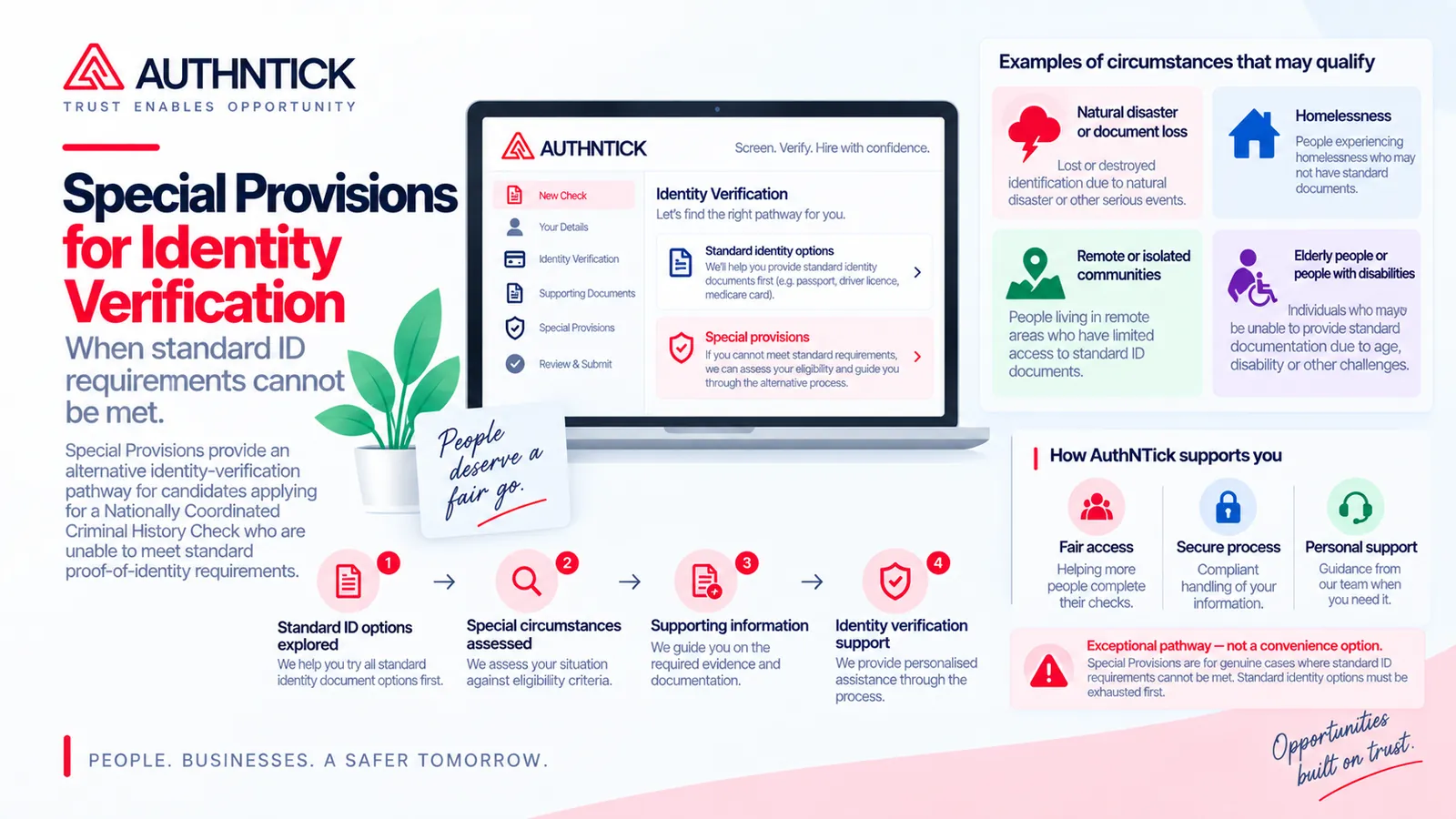
Special Provisions for Identity Verification Support
For candidates who may need additional help meeting identity verification requirements.
Nationally Coordinated Criminal History Volunteer Checks for Student Placements
For students, volunteers and placement candidates who need a Nationally Coordinated Criminal History Volunteer Check.
Probity Screening and Integrity Checks
For employment, licensing, regulated roles and integrity-based screening.
Free Nationally Coordinated Criminal History Check in Australia
Explains when a Nationally Coordinated Criminal History Check may be free or discounted and when fees apply.
Special Background Checks
Learn about special-purpose background checks and when additional screening may be needed.
Minimum ID Needed for a Nationally Coordinated Criminal History Check
Understand identity document requirements before applying for a Nationally Coordinated Criminal History Check.
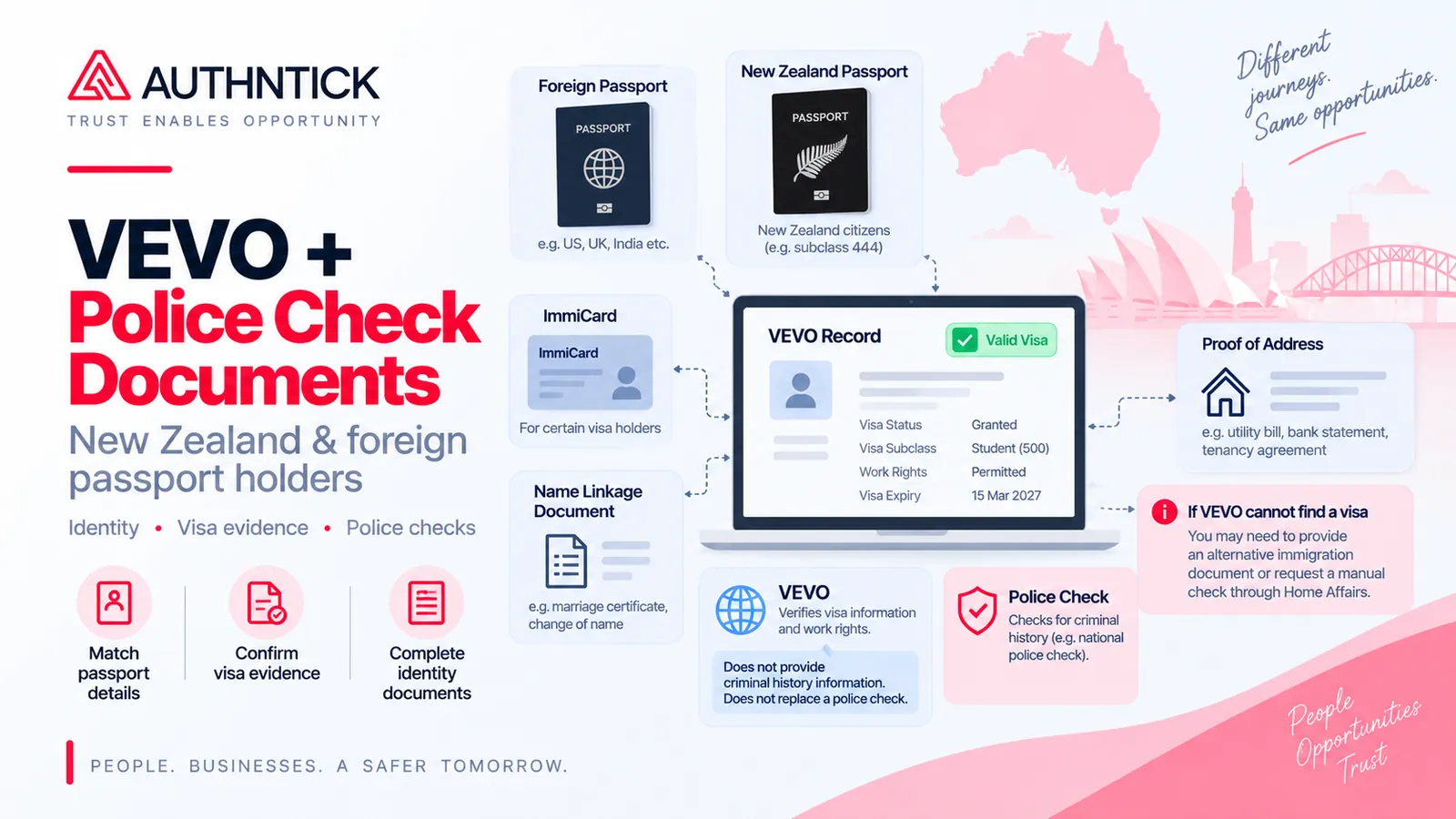
New Zealand and Foreign Passport Holder Documents
For New Zealand citizens and foreign passport holders who may need passport, VEVO or visa entitlement evidence.
Ready to start or continue your Nationally Coordinated Criminal History Check?
AuthNTick is a private ACIC-accredited provider and is not a government agency. Our secure online application is mobile-friendly, supported by an Australian team, and designed to help you provide the right details before submission.

About the author
Dev Tripathi
Editorial contributor and cybersecurity adviser
Dev Tripathi is a senior cybersecurity, risk and compliance professional with more than 20 years of experience. At AuthNTick, he contributes to and reviews guidance on Nationally Coordinated Criminal History Checks, identity verification, privacy, information security and workforce compliance.
Editorial references
Official and authoritative sources
Use these primary and authoritative references to confirm current requirements for the topic covered in this guide.
- ACIC service Australian Criminal Intelligence Commission
- How the ACIC service works Australian Criminal Intelligence Commission
- Nationally Coordinated Criminal History Check validity Australian Criminal Intelligence Commission
- Identity verification services IDMatch, Australian Government
This guide is general information, not legal advice. Government processes and employer requirements can change, so check the linked source and the requesting organisation’s instructions before acting. Read our editorial and corrections policy.
Next step
Ready to move from research to action?
Use AuthNTick to complete secure Australian background checks, or speak with our team if you need the right workflow for your organisation.