Introduction
New Zealand citizens and other foreign passport holders applying for a Nationally Coordinated Criminal History Check may need documents that establish both their identity and their Australian immigration status.
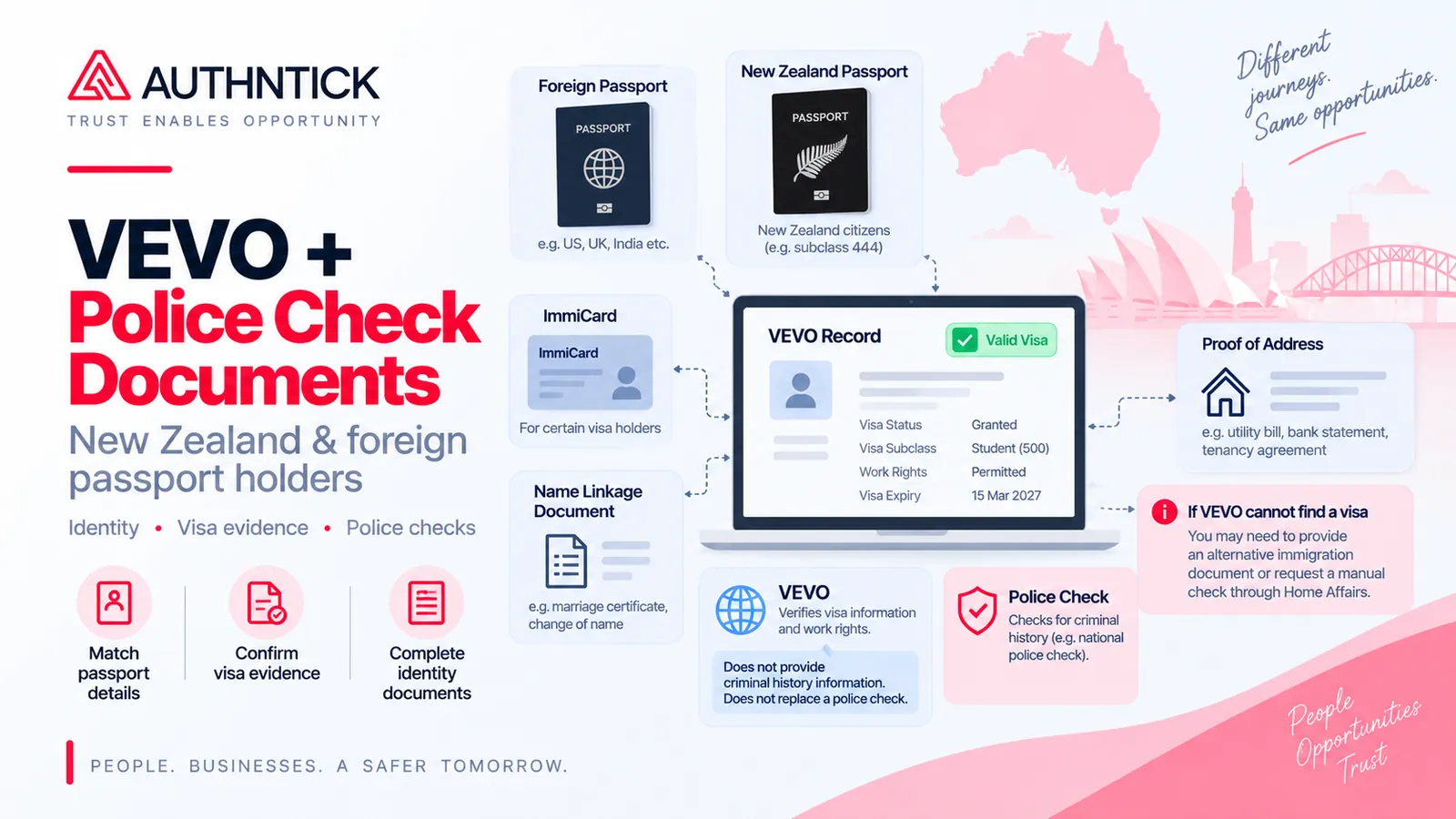
A foreign passport is an important identity document, but it may not satisfy every police-check identity category by itself. Depending on the candidate’s circumstances, a current matching Visa Entitlement Verification Online (VEVO) record or another acceptable Australian immigration document may be needed as commencement-of-identity evidence.
This guide focuses on police-check document requirements. For employer or organisation work-rights verification, see AuthNTick’s VEVO work-rights check page.
Quick answer
- A foreign or New Zealand passport may not satisfy every police-check identity category by itself.
- A current matching VEVO record or another acceptable Australian immigration document may be required as commencement-of-identity evidence.
- Candidates will generally also need proof of their current residential address and additional identity documents.
- The exact documents depend on the candidate’s circumstances and the documents available.
- Follow the document requirements displayed during the AuthNTick application.
Choose the police check for criminal-history screening. Choose VEVO for visa-entitlement or work-rights verification. A VEVO check does not replace a police check.
Documents commonly required
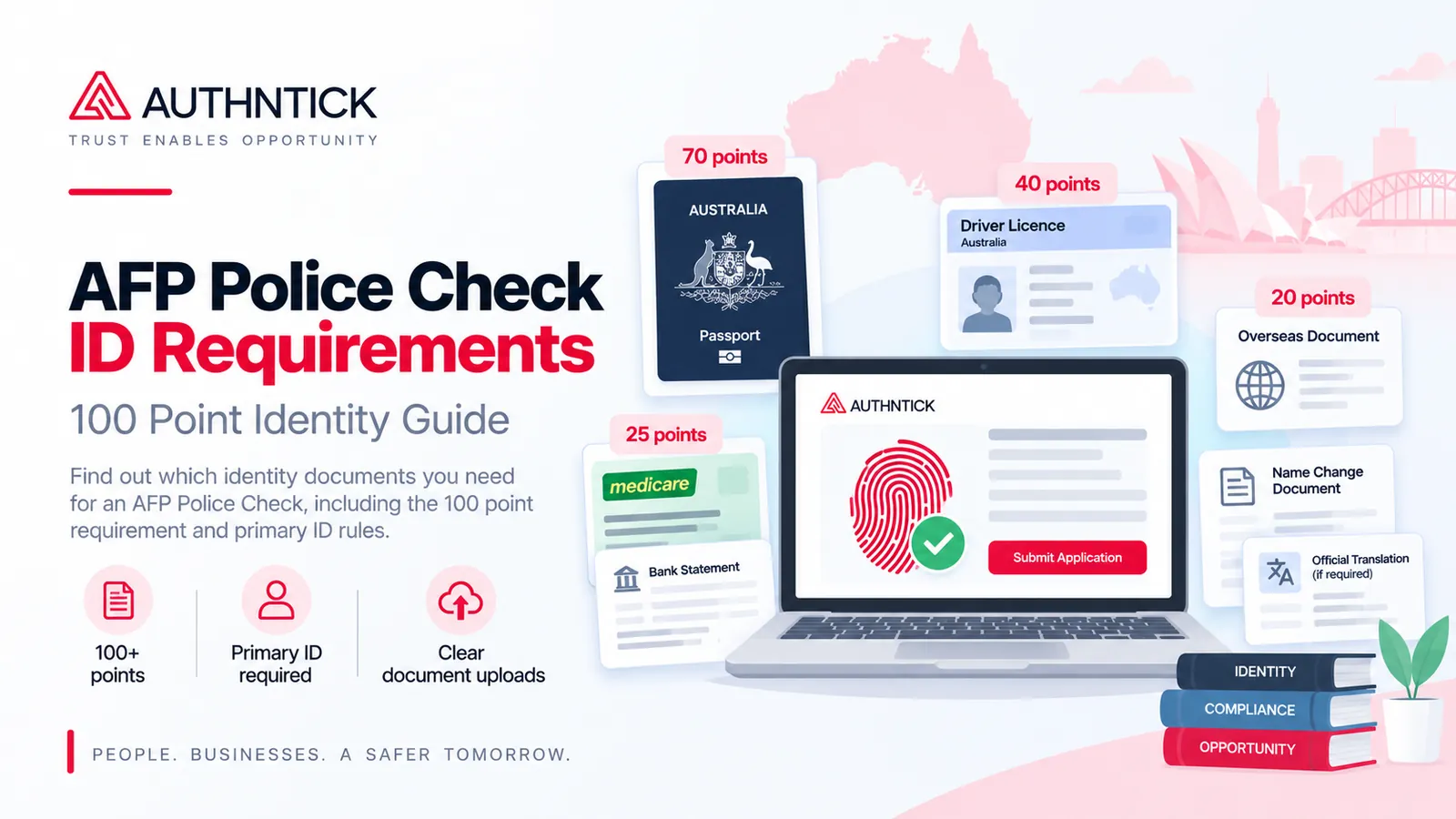
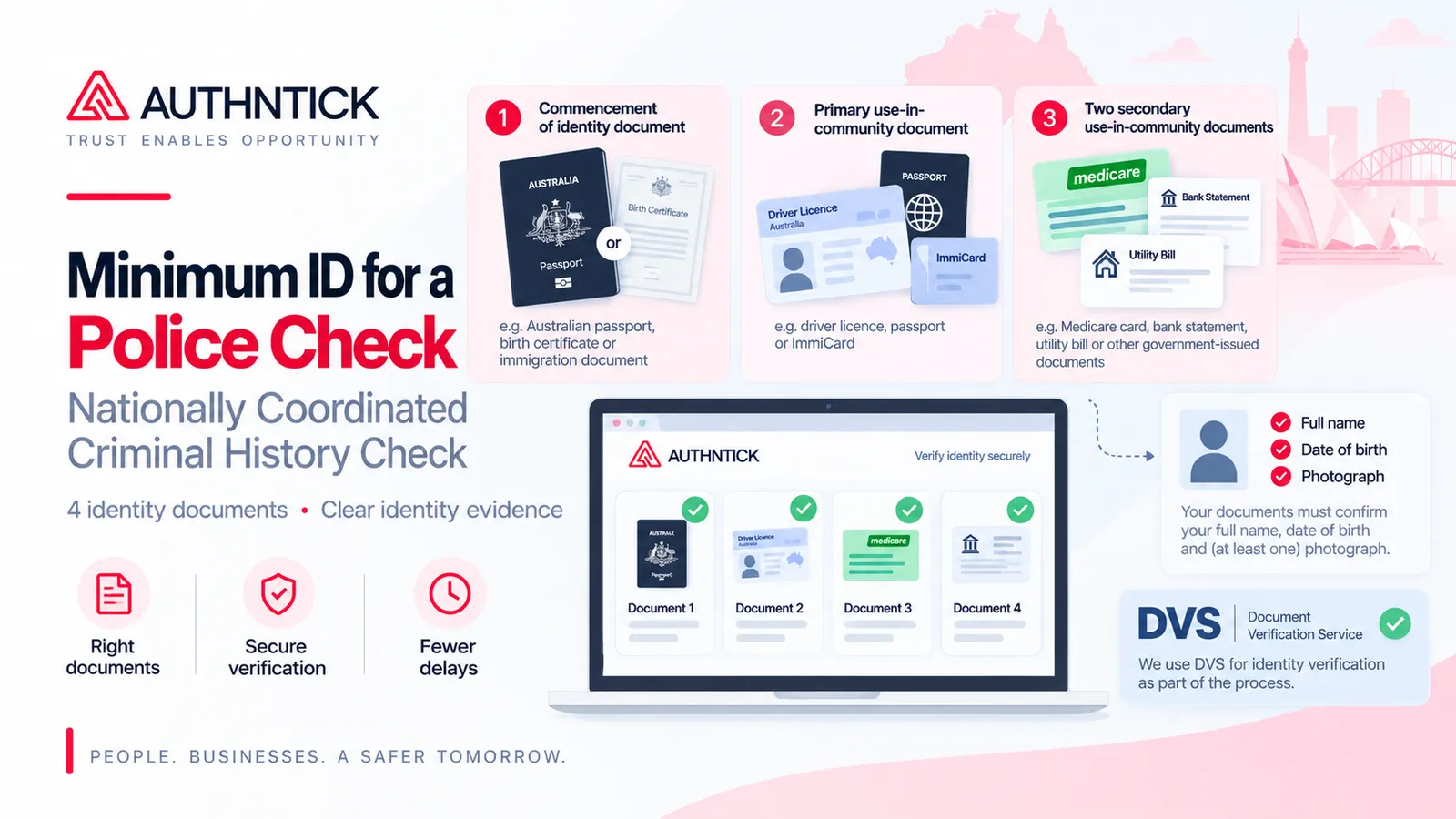
The Australian Criminal Intelligence Commission (ACIC) states that candidates need four identity documents, including one commencement-of-identity document. The document combination must also link the person to the identity being checked.
The following summary is general guidance only. A listed document is not automatically accepted; its currency, details and identity category must meet the requirements displayed in the application.
| Candidate circumstance | Possible commencement-of-identity evidence | Other documents generally required | Important note |
|---|---|---|---|
| Foreign passport holder with an electronically recorded visa | Current matching VEVO record or printout | Current passport, proof of address and additional identity documents | Passport and VEVO details should relate to the same person. |
| New Zealand citizen currently in Australia | Current VEVO record or another acceptable immigration-status document | New Zealand passport, proof of address and additional identity documents | A New Zealand passport alone may not satisfy every identity category. |
| ImmiCard holder | An eligible, current ImmiCard | Proof of address and additional identity documents | Acceptance depends on the document and the applicable identity requirements. |
| Candidate with a historical or non-electronic visa | An acceptable Home Affairs record or other official immigration document | Current identity, address and any historical supporting documents requested | Home Affairs may need to create or confirm an electronic record. |
| Australian citizen who previously held a visa | Current Australian passport, full birth certificate or citizenship certificate | Proof of address and additional identity documents | A historical visa is not current proof of Australian citizenship. |
| Candidate whose documents show different names | The applicable document for the candidate’s status | Official name-linkage evidence plus the required identity documents | All documents must be linked clearly to the person applying. |
For a broader explanation of the categories, read the guide to identity documents for a police check. AuthNTick may also use the Australian Government’s Document Verification Service in supported identity workflows; learn how DVS identity verification works.
What is VEVO?
VEVO stands for Visa Entitlement Verification Online. It is a Department of Home Affairs service that allows visa holders and authorised organisations to check visa information and conditions recorded by Home Affairs.
A VEVO record may display the visa in effect, visa subclass, period of stay, work or study rights and applicable conditions. It only displays information available in Home Affairs’ electronic systems and does not determine the outcome of a police check.
VEVO check vs police check
These checks answer different questions and one does not replace the other.
| Check | What it confirms | What it does not confirm | Why it may be required |
|---|---|---|---|
| VEVO check | Visa information and conditions recorded by Home Affairs | Criminal-history information | Immigration-status evidence or work-rights verification |
| Nationally Coordinated Criminal History Check | Relevant police information released under the applicable checking process | Current visa conditions or work rights | Employment, licensing, registration or another authorised purpose |
An employer or candidate may require both checks for different purposes. An AFP Police Check may instead be required for certain Commonwealth, immigration or overseas purposes; follow the instructions of the organisation requesting the check.
Foreign passport holders
Where a current foreign passport is used with a VEVO record, the valid foreign passport associated with that visa record should relate to the same person. The name, date of birth and passport details should be consistent with Home Affairs records and the police-check application.
If a visa is linked to an expired or replaced passport, the candidate may need to update their passport details with Home Affairs before the visa can be linked to the current passport. Candidates should not assume that a foreign passport and VEVO record together satisfy every identity category; proof of address and other identity documents are generally still required.
New Zealand citizens and subclass 444 visas
Eligible New Zealand citizens are generally granted a subclass 444 Special Category Visa when entering Australia on a valid New Zealand passport. The subclass 444 visa is generally temporary and ordinarily ceases when the person leaves Australia.
A New Zealand passport alone may not satisfy every police-check identity category. Depending on the person’s circumstances, a current VEVO record or another acceptable immigration-status document may be required, along with proof of address and additional identity documents.
A historical arrival date does not automatically establish current permanent-resident status. Home Affairs determines a person’s immigration status and eligibility; this article does not provide individual immigration advice.
Alternative immigration documents
Not every candidate has a conventional passport or passport-searchable electronic visa record. Depending on the document, its currency and the applicable police-check identity requirements, an official immigration or travel document may be relevant.
ImmiCard
An ImmiCard is issued to certain visa holders who do not have and cannot obtain a passport recognised by the Australian Government. It can assist an eligible holder to show commencement of identity in Australia, but additional documents may still be required.
Document for Travel to Australia (DFTTA)
A DFTTA may be issued to certain offshore refugee or humanitarian visa holders for their initial journey to Australia. It should not automatically be treated as a current, general-purpose passport substitute after that journey; acceptance depends on its status, details and the applicable identity requirements.
PL056 or M56 Visa Evidence Card
PL056 or M56 cards are historical Visa Evidence Cards that may have been issued to some Protection or Bridging visa holders. Additional current identity or immigration evidence may be needed.
Convention Travel Document
A Convention Travel Document, sometimes called a Titre de Voyage, may be issued to an eligible refugee or other qualifying person who cannot obtain a passport from their country of nationality. It does not automatically establish current Australian visa conditions, so a VEVO record, ImmiCard or another official Home Affairs document may also be needed.
What if VEVO cannot find the visa?
Before seeking help, check:
- the spelling of the candidate’s name;
- the date of birth;
- the passport number;
- the visa grant number or transaction reference number;
- whether the visa is linked to an old passport; and
- whether passport details need to be updated with Home Affairs.
Also consider whether the person has a historical or non-electronic immigration record. Contact the Department of Home Affairs if the record remains unavailable or incorrect.
A failed VEVO search does not, by itself, prove that a person has no lawful immigration status. AuthNTick cannot create, change or link the underlying visa record.
Historical and non-electronic visa records
Some long-term residents may not have a searchable electronic visa record. Home Affairs advises that a person may not have an electronic record if their last arrival was before 1990. An eligible person who already holds a permanent visa may be able to request that the existing permanent visa be recorded electronically.
This process records an existing permanent visa; it does not automatically grant a new visa or create permanent-resident status. Home Affairs may request first-arrival and later travel evidence, old passports, historical visa documents, identity documents and proof of Australian residence.
Resident Return Visas
Home Affairs guidance says a person who arrived before 1 June 1959 and has not left Australia, or an eligible New Zealand citizen who arrived before 1 September 1994, may in particular circumstances be considered a former permanent resident and eligible to apply for a Resident Return Visa (RRV), subclass 155 or 157. Historical arrival alone is not proof of current permanent-resident status.
A person applying for an RRV does not necessarily need a separate electronic visa-record request first. A long-term permanent resident who does not intend to travel but needs electronic evidence may instead be able to request an electronic record of an existing permanent visa. Home Affairs decides which process applies.
Name differences and document mismatches
The documents must consistently link the candidate to the identity being checked. If a passport, VEVO record, ImmiCard or other document shows a different name, the candidate may need an official name-linkage document, such as an Australian marriage certificate, change-of-name certificate, deed poll or another recognised government-issued document.
Enter details exactly as instructed in the application. If a Home Affairs record contains an error, contact Home Affairs; AuthNTick cannot amend the record.
Checklist before applying
Before starting a police-check application, confirm that you have:
- an acceptable commencement-of-identity document;
- a current passport, where applicable;
- a current matching VEVO record or another acceptable immigration document, where required;
- proof of your current residential address;
- the additional identity documents requested in the application;
- clear, readable copies of the documents; and
- official evidence linking any different names.
Follow the document instructions displayed during the AuthNTick application because the exact combination depends on your circumstances and available evidence.
Choose the check that matches your purpose
A police check searches relevant criminal-history information. VEVO verifies visa entitlements or work rights; it does not replace the police check.
Frequently asked questions
Is a foreign passport enough for an Australian police check?
Not usually by itself. A foreign passport may satisfy one identity category, but you may also need a matching VEVO record or another acceptable commencement-of-identity document, proof of address and additional identity documents.
Do New Zealand citizens need VEVO for a police check?
They may, depending on their circumstances and available documents. A New Zealand passport alone may not satisfy every identity category, so a current VEVO record or another acceptable immigration-status document may be required.
Is VEVO the same as a police check?
No. VEVO confirms visa information and conditions recorded by Home Affairs. A Nationally Coordinated Criminal History Check searches relevant police information under the applicable checking process.
Does VEVO show criminal history?
No. VEVO does not provide criminal-history information. It displays visa information and conditions available in Home Affairs records.
Does the VEVO record need to match the current passport?
Where passport-based visa evidence is used, the VEVO and passport details should relate to the same person and match the information held by Home Affairs.
What happens if the visa is linked to an old passport?
Check the old passport details and follow Home Affairs guidance to update or link the current passport where required. AuthNTick cannot change the underlying visa record.
Can an ImmiCard be used instead of a passport?
An eligible, current ImmiCard may help establish commencement of identity for a person who cannot obtain a passport recognised by the Australian Government. Additional identity documents may still be required.
What should I do if VEVO cannot find my visa?
Check the name, date of birth, passport and reference details, including whether the visa is linked to an old passport. Contact Home Affairs if the record remains unavailable or incorrect.
Can AuthNTick change a VEVO or visa record?
No. AuthNTick cannot create, amend or link Home Affairs visa records. The Department of Home Affairs maintains the underlying immigration information.
Does a subclass 444 visa make a New Zealand citizen a permanent resident?
No. The subclass 444 Special Category Visa is generally a temporary visa. A historical arrival date also does not, by itself, establish current permanent-resident status.
Can an Australian citizen use VEVO as current proof of status?
VEVO is used for visa information, not to prove Australian citizenship. An Australian citizen should use an acceptable current commencement-of-identity document for the police-check application.
What should I do if my identity documents show different names?
Provide an acceptable official document that links the names, such as a marriage certificate or change-of-name certificate, and enter your details as instructed in the application.
Important notice
This article provides general information about identity-document and visa-evidence requirements. It is not legal or immigration advice. AuthNTick is not a government department or police agency.
Home Affairs determines visa status, permanent residence, subclass 444 eligibility, electronic visa-record requests and RRV eligibility. Identity requirements vary with the check and purpose; review the current application instructions and official guidance before relying on this article.
Start your check
Choose a Nationally Coordinated Criminal History Check when you need criminal-history screening, or VEVO when you need visa-entitlement or work-rights verification. Organisations can contact AuthNTick about a broader screening workflow.

About the author
Dev Tripathi
Editorial contributor and cybersecurity adviser
Dev Tripathi is a senior cybersecurity, risk and compliance professional with more than 20 years of experience. At AuthNTick, he contributes to and reviews guidance on Nationally Coordinated Criminal History Checks, identity verification, privacy, information security and workforce compliance.
Editorial references
Official and authoritative sources
Use these primary and authoritative references to confirm current requirements for the topic covered in this guide.
- Identity documents for a Nationally Coordinated Criminal History Check Australian Criminal Intelligence Commission
- VEVO for visa holders Department of Home Affairs
- Special Category Visa (subclass 444) Department of Home Affairs
- ImmiCard Department of Home Affairs
- Proof of permanent residency and electronic visa records Department of Home Affairs
- VEVO for organisations Department of Home Affairs
- Work restrictions and employer obligations Department of Home Affairs
This guide is general information, not legal advice. Government processes and employer requirements can change, so check the linked source and the requesting organisation’s instructions before acting. Read our editorial and corrections policy.