Probity screening and integrity checks
This guide explains probity screening, integrity checks and licensing background check contexts. For standard criminal history screening, see the Nationally Coordinated Criminal History Check hub.
When to Use Them and What They Cover
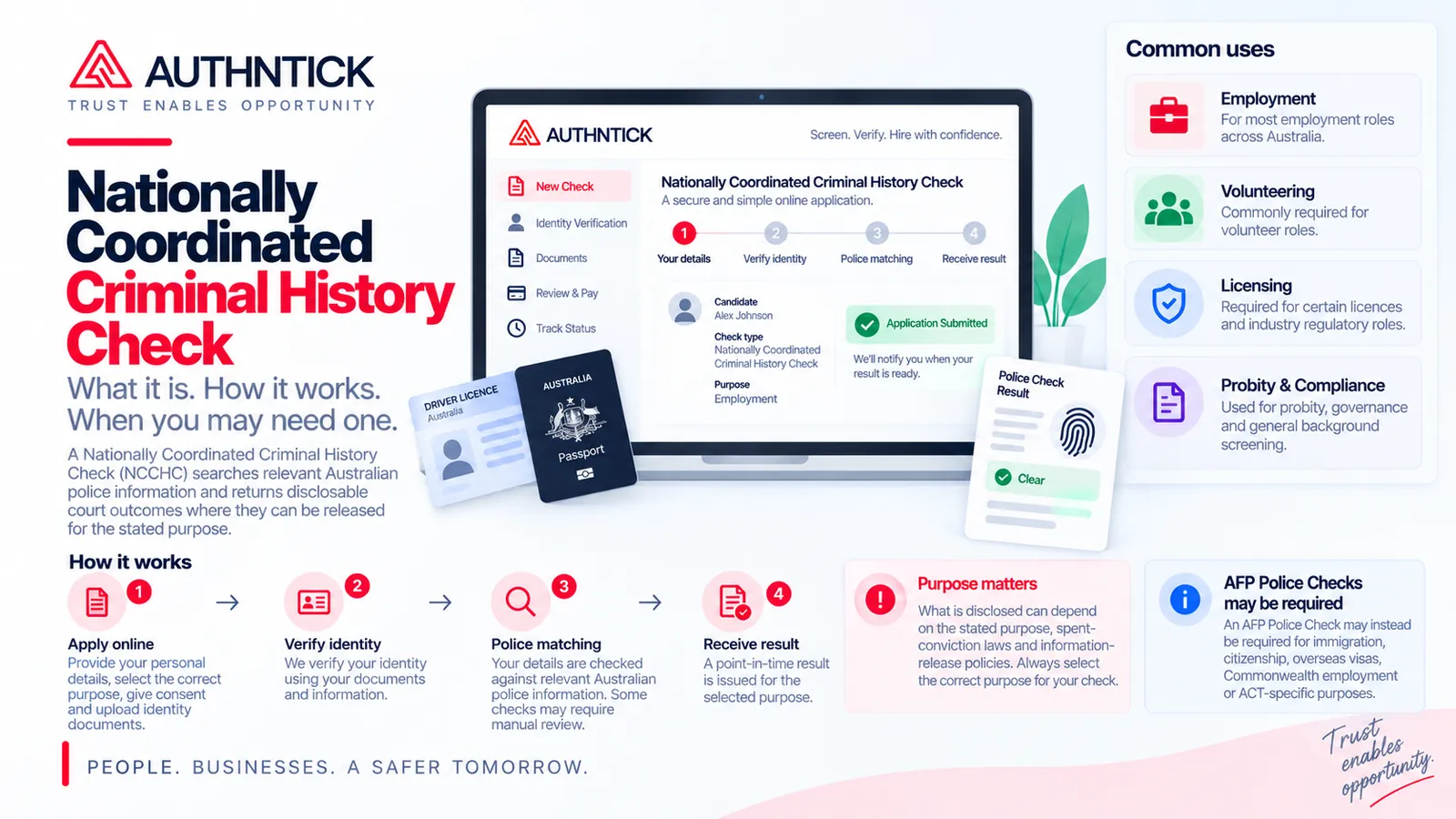
In the context of Nationally Coordinated Criminal History Check (NCCHC) applications, probity refers to assessing whether a person is suitable for a position of trust. While probity checks are often associated with employment and volunteering, they can also apply to personal, licensing, governance, and other non-employment situations where trust, integrity, and public confidence matter.
Need a Nationally Coordinated Criminal History Check for Probity, Work, or Licensing?
AuthNTick helps individuals and organisations apply for the right Nationally Coordinated Criminal History Check quickly, securely, and with clear guidance on the correct screening category.
What Is a Probity Check?
A probity check is used to assess an individual's background and determine whether they are suitable for a position of trust. It is commonly used where a role involves reputation, responsibility, public confidence, governance, financial control, or contact with vulnerable people.
Nationally Coordinated Criminal History Checks are commonly requested for employment and probity purposes. The probity category can also be relevant for non-employment purposes such as board appointments, personal placements, public-facing roles, and certain regulated activities.
When Is the Probity Category Used?
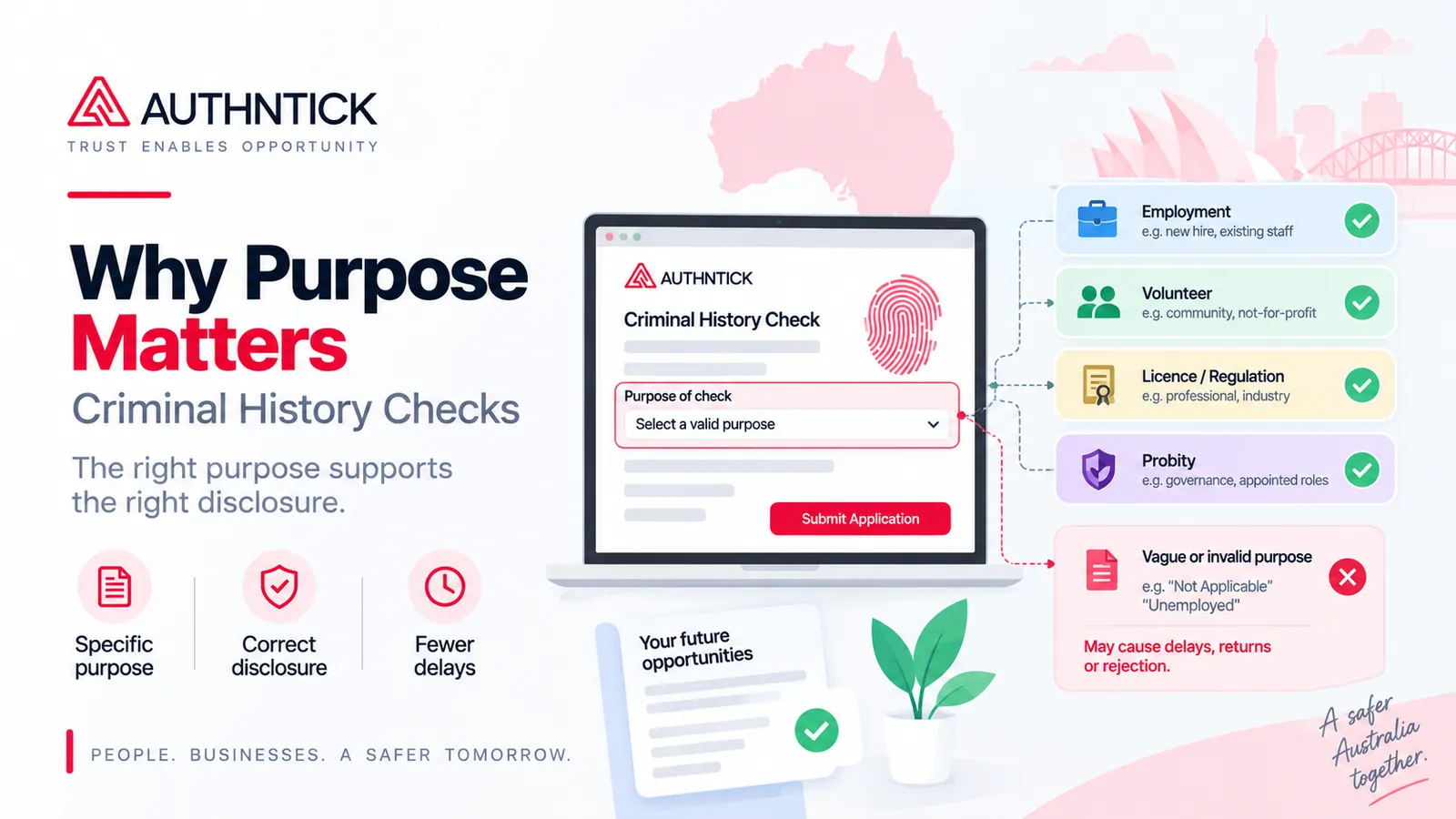
The probity category is typically used where the check is not strictly for standard employment, but where trust, integrity, or public confidence still need to be assessed.
Examples may include:
Probity - Non-Volunteer
- Placement of an Au Pair, private residence, Canberra, Australian Capital Territory
- Caravan purchase arrangement, Best Beach Resort and Caravan Park, Byron Bay, New South Wales
Probity - Volunteer
- Volunteer Support Coordinator, Cancer Council Australia, Sydney, New South Wales
- Student medical placement, Bachelor of Medicine, Flinders University, Adelaide, South Australia
- Volunteer Aged Care Visitor, Bendigo Blue Aged Care Centre, Bendigo, Victoria
- Volunteer Tour Guide, Australian War Memorial, Canberra, Australian Capital Territory
What Probity Screening Typically Includes
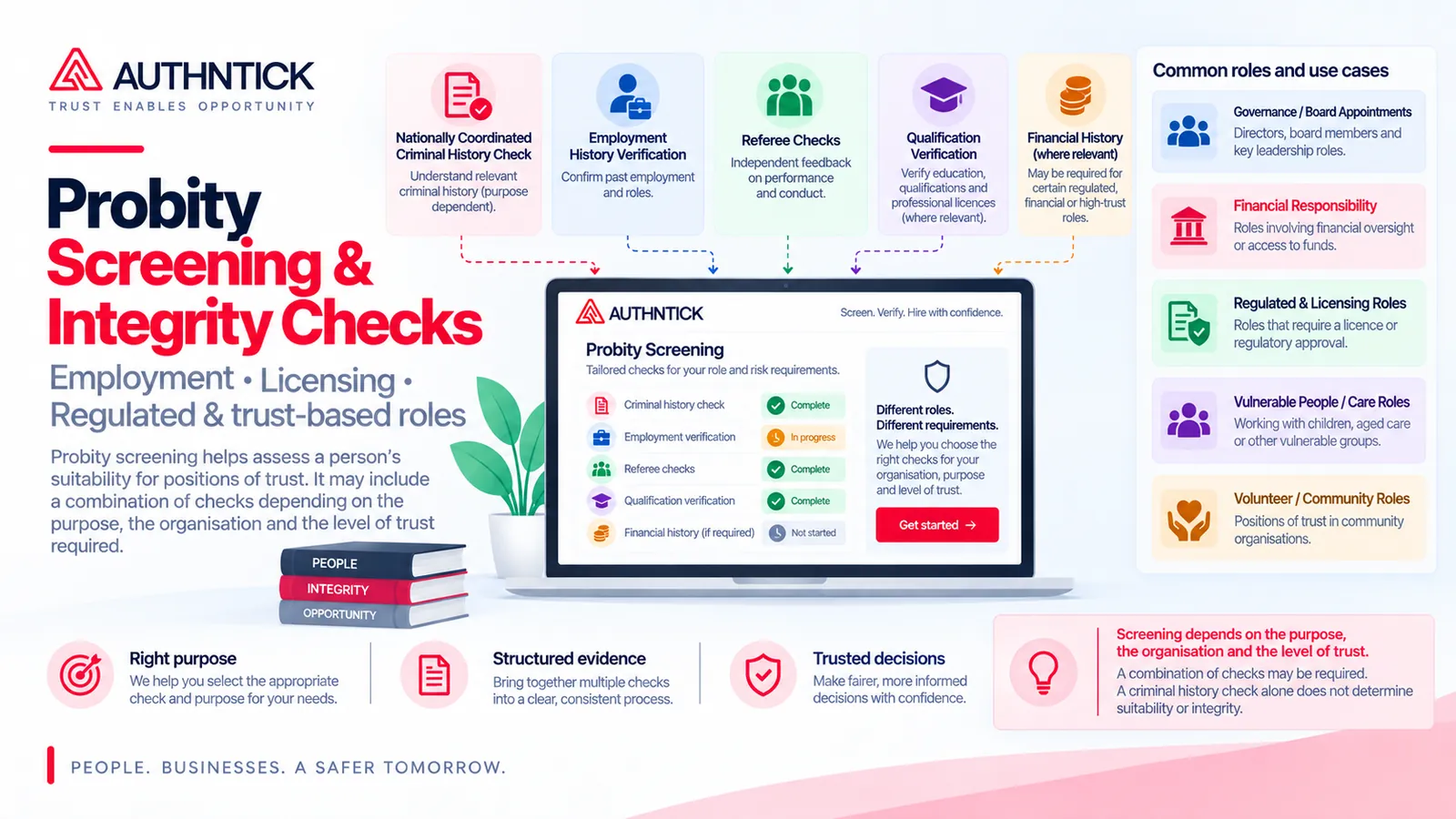
Probity screening can vary depending on the purpose of the role, the organisation, and the level of trust involved. In many cases, it may include a combination of the following checks:
Nationally Coordinated Criminal History Check (NCCHC)
Used to identify disclosable court outcomes, criminal history information, or unresolved matters that may be relevant to the position or purpose of the check.
Employment History Verification
Reviews of past employment may help identify inconsistencies, dishonesty, or misconduct that could affect a person's suitability for a trusted role.
Financial History Checks
In some positions, especially where money, procurement, or fiduciary obligations are involved, financial history screening may be relevant to assess risks such as bankruptcy or other financial concerns.
Referee Checks
Reference Checks collect role-relevant employment confirmations and observed performance, conduct and suitability responses. AuthNTick offers AI-generated, pre-built and custom questionnaires and retains the underlying referee evidence for customer review.
Qualification Verification
Qualification checks help confirm that the qualifications or credentials relied on by an candidate are genuine, current, and accurately represented.
Common Areas Where Probity Screening Is Used
Probity screening is often used where organisations need extra confidence that an individual can be trusted in a role involving responsibility, public confidence, or access to sensitive matters.
- Government roles and positions involving national security
- Banking and financial services, where trust and integrity are essential
- Childcare, healthcare, and care-based environments
- Licensing and permit applications for regulated professions
- Board, committee, or governance appointments
- Volunteer and community-facing positions with heightened trust obligations
In each case, the goal is to help ensure that the individual is suitable for a role where they may handle sensitive information, interact with vulnerable people, represent an organisation publicly, or contribute to public safety.
Why Choose AuthNTick for Probity Screening?
Choosing the right provider matters when you need a check completed quickly, accurately, and with clear support. AuthNTick helps individuals and organisations navigate the correct Nationally Coordinated Criminal History Check purpose and apply with confidence.
- Fast and responsive service to help reduce delays
- Clear customer support if you are unsure which category to choose
- No hidden fees with transparent upfront pricing
- Secure online application process designed for speed and accuracy
Whether you need a Nationally Coordinated Criminal History Check for probity, employment, licensing, or volunteering, AuthNTick helps you apply for the right check with less hassle and better visibility throughout the process.
Get Your Nationally Coordinated Criminal History Check Fast with AuthNTick
No delays, no hidden fees, and clear support when you need help choosing the right Nationally Coordinated Criminal History Check purpose. Start your application with AuthNTick today.
Helpful NCCHC Guides
Use these related guides to understand the right Nationally Coordinated Criminal History Check pathway for your situation, whether you are applying for employment, volunteering, identity support, processing time, probity or special background screening.
Pre-Employment Screening Guide for Australian Employers
For employers and recruiters who need pre-employment background checks and screening workflows.
Nationally Coordinated Criminal History Check Processing and Approval Time
Understand how long a Nationally Coordinated Criminal History Check may take and why some checks are delayed.
Special Provisions for Identity Verification Support
For candidates who may need additional help meeting identity verification requirements.
Nationally Coordinated Criminal History Volunteer Checks for Student Placements
For students, volunteers and placement candidates who need a Nationally Coordinated Criminal History Volunteer Check.
Probity Screening and Integrity Checks
For employment, licensing, regulated roles and integrity-based screening.
Free Nationally Coordinated Criminal History Check in Australia
Explains when a Nationally Coordinated Criminal History Check may be free or discounted and when fees apply.
Special Background Checks
Learn about special-purpose background checks and when additional screening may be needed.
Minimum ID Needed for a Nationally Coordinated Criminal History Check
Understand identity document requirements before applying for a Nationally Coordinated Criminal History Check.
New Zealand and Foreign Passport Holder Documents
For New Zealand citizens and foreign passport holders who may need passport, VEVO or visa entitlement evidence.
Ready to start or continue your Nationally Coordinated Criminal History Check?
AuthNTick is a private ACIC-accredited provider and is not a government agency. Our secure online application is mobile-friendly, supported by an Australian team, and designed to help you provide the right details before submission.

About the author
Dev Tripathi
Editorial contributor and cybersecurity adviser
Dev Tripathi is a senior cybersecurity, risk and compliance professional with more than 20 years of experience. At AuthNTick, he contributes to and reviews guidance on Nationally Coordinated Criminal History Checks, identity verification, privacy, information security and workforce compliance.
Editorial references
Official and authoritative sources
Use these primary and authoritative references to confirm current requirements for the topic covered in this guide.
- ACIC service Australian Criminal Intelligence Commission
- How the ACIC service works Australian Criminal Intelligence Commission
- Nationally Coordinated Criminal History Check validity Australian Criminal Intelligence Commission
- AS 4811:2022 Workforce screening Standards Australia
This guide is general information, not legal advice. Government processes and employer requirements can change, so check the linked source and the requesting organisation’s instructions before acting. Read our editorial and corrections policy.
Next step
Ready to move from research to action?
Use AuthNTick to complete secure Australian background checks, or speak with our team if you need the right workflow for your organisation.