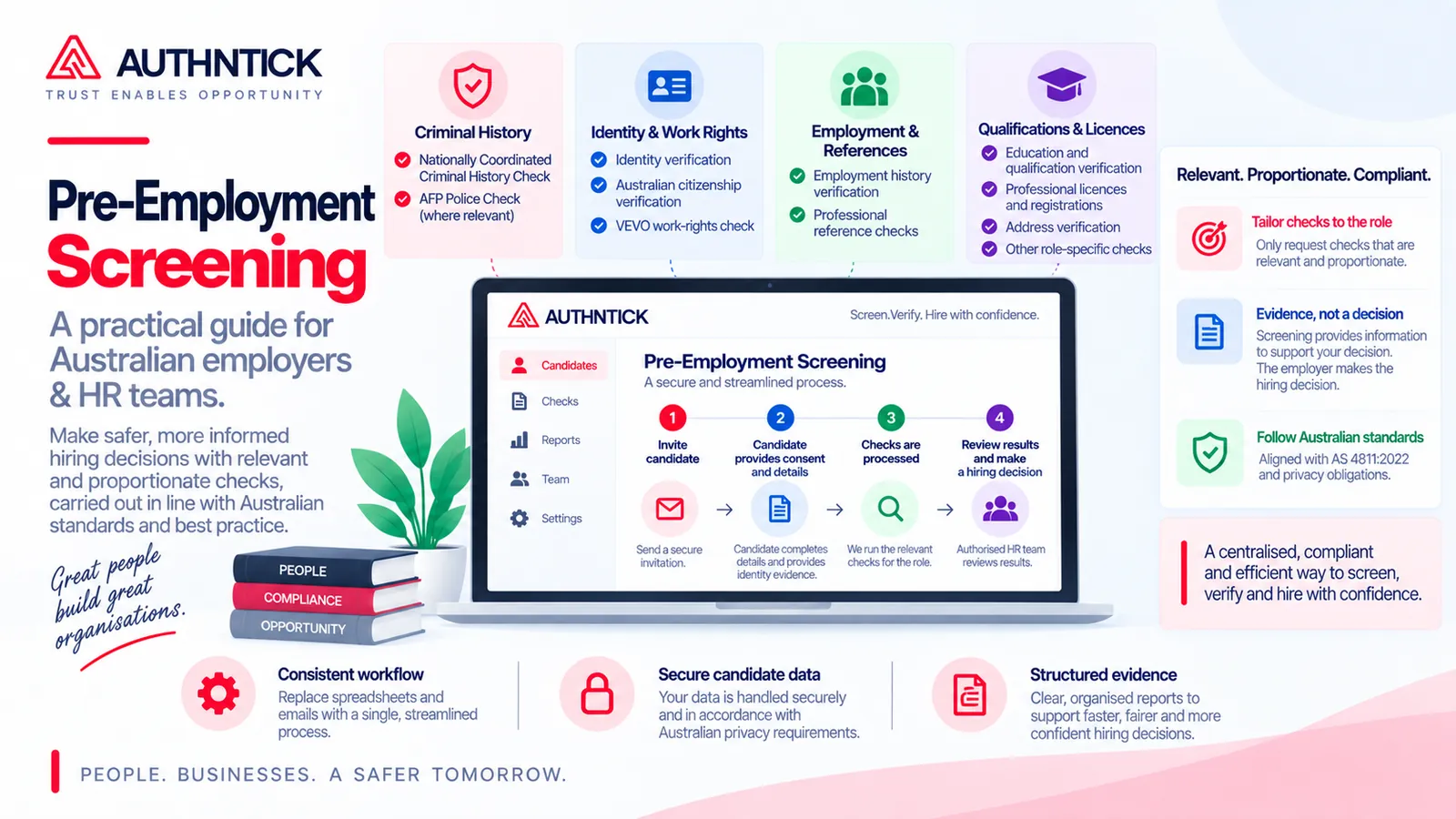
Pre-employment screening in Australia helps hiring teams gather and review evidence about candidates, from the first application to role-relevant background checks.
For HR, recruitment and compliance teams, the practical challenge is connecting that evidence without repeatedly chasing documents, building questionnaires or moving results between inboxes. AuthNTick brings screening, assessments, interviews and verification into a connected workflow, with employment decisions remaining with your organisation.
What is pre-employment screening?
Pre-employment screening is a structured process for collecting, checking and considering information relevant to a proposed role. Employee background checks in Australia are one part of that process; application review, skills assessments and interviews can contribute different evidence.
- Screening
- The broader process of reviewing applications and gathering role-relevant information.
- Assessment
- Questions or tasks that explore knowledge, skills and judgement against the role’s requirements.
- Verification
- Comparing candidate information with documents, records or source responses, within the scope of each check.
A pre-employment assessment does not verify a qualification, and a verified qualification does not demonstrate every skill needed for a job. These are complementary inputs to a human decision.
Why do employers conduct pre-employment screening?
Hiring teams use screening to clarify material claims, understand relevant work entitlements, assess job-related capabilities and identify information that needs follow-up. A consistent process can also support an organisation’s documented screening requirements and reduce repeated administration.
Results do not guarantee honesty, safety, suitability or future performance. An incomplete record or a discrepancy needs context; it is not automatically evidence of misconduct. Decide what matters to the role before requesting information.
What can pre-employment screening include?
Pre-employment checks may cover identity, criminal history, visa work rights, employment history, education, references, address history and relevant public online information. CV screening, skills assessments and interviews help teams explore the application and the candidate’s responses.
Not every candidate requires every check. Select a proportionate package, explain its purpose, obtain the required consent and agree who may review the results. Some roles need a separate licence, professional registration or statutory screening process; do not assume a general background check replaces it.
A connected pre-employment screening process
Build the hiring screening process around five stages. The timing can vary: for example, you may need to establish a relevant work entitlement before investing in later assessments.
- 01Screen→
- 02Assess→
- 03Interview→
- 04Verify→
- 05Review
From application to verified candidate
One possible sequence, with checks selected for the role:
- 01CV Screening↓
- 02AI Assessment↓
- 03AI Interview↓
- 04Candidate Comparison↓
- 05Identity & Background Checks↓
- 06Evidence Review
“Verified” refers to the information checked and the evidence available. It is not an overall approval of the candidate.
1. Screen candidates
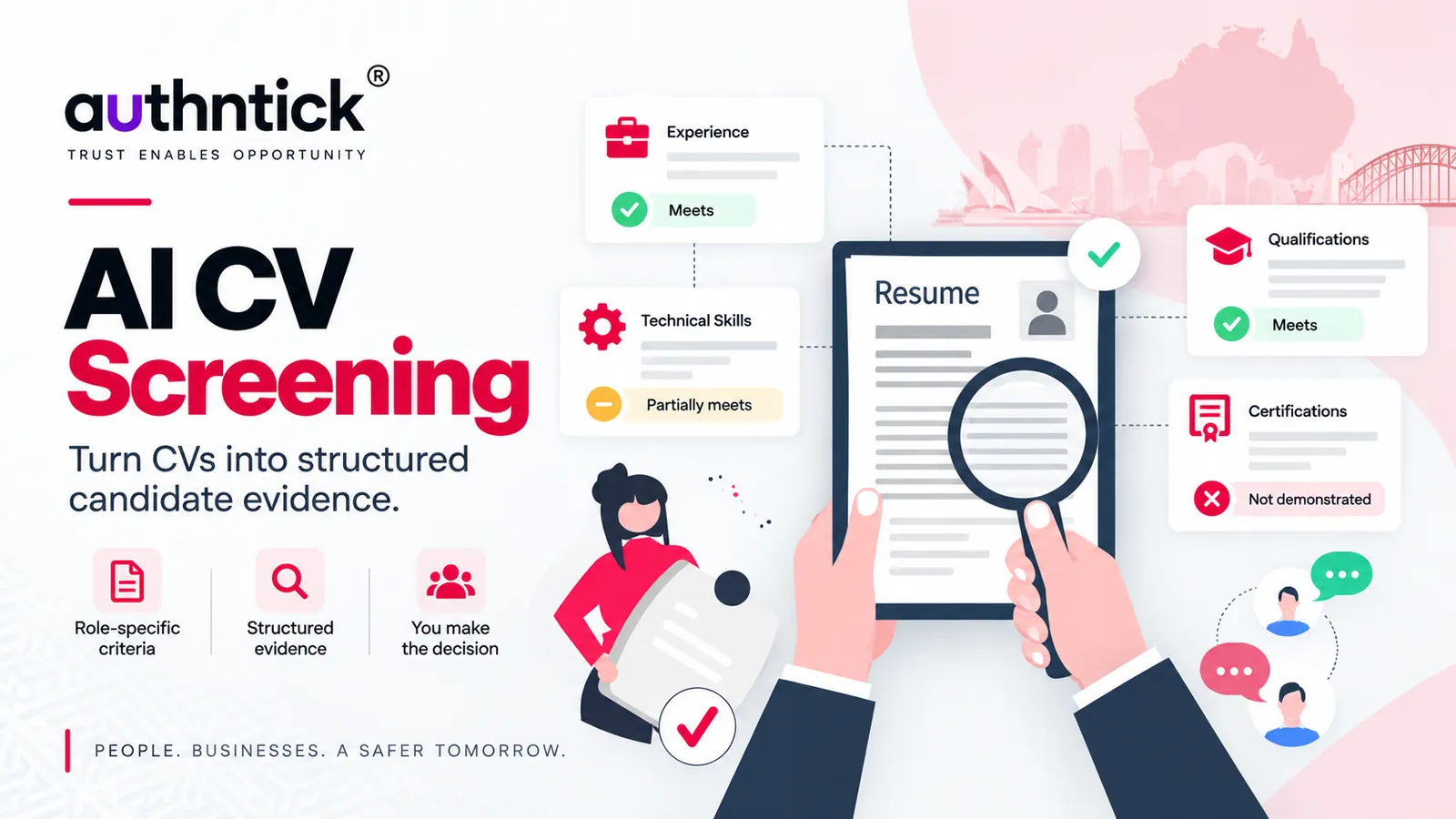
AI CV Screening
AI CV Screening helps organise application information against role requirements. Teams provide the job context and CVs, then review the resulting evidence, areas of alignment and gaps that need clarification. This can reduce manual reading when handling multiple applications.
A CV remains candidate-provided information. AI-assisted screening does not independently verify its claims or make the hiring decision. Review the evidence behind an output and avoid treating missing information as proof that a candidate lacks a capability.
Social Media Checks
A Social Media Check may be appropriate where a documented, role-relevant public-source review is justified. Candidates provide consent, profile URLs, usernames, visibility information and ownership confirmation. AuthNTick reviews accounts individually and records relevant findings with supporting evidence and context.
The structured result distinguishes clear accounts, concerns for review and accounts that cannot be reviewed. A private or inaccessible account is a limitation, not automatically an adverse finding. AuthNTick does not ask for passwords or require candidates to change privacy settings. Authorised employers assess attribution, relevance and context; the report does not decide whether to hire.
2. Assess candidates
AI Assessments / Skills Assessments
AI Assessments help teams generate role-specific assessments in minutes. Start with the role, job description and skills, review the generated questions and scoring, then invite candidates. Teams can also use templates or create custom questions, including choice-based questions and written responses.
Use job-relevant knowledge and judgement scenarios to explore how candidates approach the work. Structured results bring answers, scores and explanations together for review. This reduces the manual work of designing and administering assessments, while the hiring team checks question quality, difficulty and relevance before use.
Give candidates clear instructions and discuss any adjustments they need. Interpret scores within the assessment’s scope, alongside other evidence. The skills assessment guide explains the creation and review process.
AI-powered candidate assessment
Screen, assess and interview candidates with less manual work.
- ScreenAI CV Screening
Review applications against role criteria.
- AssessAI Assessments
Generate role-specific assessments in minutes.
- InterviewAI Interviews
Run structured interviews with intelligent follow-ups.
- CompareCandidate Comparison
Compare role-relevant evidence clearly.
- ReviewInterview Integrity
Surface session and identity signals.
Human review runs throughout. Integrity signals provide context alongside the interview evidence.
3. Interview candidates
AI Interviews
AI Interviews support a structured interview with role-relevant questions and intelligent follow-ups. Teams configure the interview, candidates respond and the resulting transcript, recording and structured evaluation provide evidence for employer review.
Consistent question areas and scoring criteria can help teams compare responses. Follow-up questions explore individual answers, so reviewers should still consider differences in the interview context. AI evaluation is an input to the organisation’s assessment, not a final employment decision.
Interview Integrity
Interview Integrity can surface session and identity signals for authorised review. Depending on the configured workflow, reviewers can consider interview recordings, desktop activity capture and browser or session signals alongside the interview record.
A signal identifies activity for review; it does not by itself prove cheating, impersonation or misconduct. Explain the configured process to candidates and investigate relevant context before drawing a conclusion.
4. Verify candidate information
Each verification service has its own information requirements, sources and result format. Request only the checks relevant to the role and read the scope and limitations of each result.
Identity Verification
Identity Verification checks supplied identity information through the applicable document-verification process. Candidates review the notice, give express consent, choose accepted documents and enter document-specific details. The current workflow requires two accepted documents to be successfully verified.
Submitted details are checked, a verification response is returned and the result is presented for review. Candidates can correct details or select another accepted document where attempts remain, and seek support when needed.
The Document Verification Service (DVS) compares relevant biographic document information with the issuing record; it does not check facial images. A matching response is limited to that matching process. It does not establish overall trustworthiness or suitability for employment.
Nationally Coordinated Criminal History Checks
The Nationally Coordinated Criminal History Check for employment returns police information that can be disclosed for the stated purpose. Candidates provide the required personal details, identity evidence and informed consent before submission through the applicable police-checking process.
The employer receives the completed result, which may contain disclosable outcomes or no disclosable court outcomes. It is a point-in-time result, subject to applicable disclosure rules. A referral for further processing is not itself an adverse outcome.
Nationally Coordinated Criminal History Volunteer Checks apply to eligible unpaid volunteer purposes. Do not use a volunteer application as a substitute for an employment-purpose check.
AFP Police Checks
An AFP Police Check is a separate product used for specified purposes, including relevant Commonwealth, immigration and overseas requirements. The applicant selects the required purpose, provides the applicable identity evidence and completes the application and consent process; the completed AFP result is then available for review.
Follow the requesting organisation’s instructions and the AFP’s purpose guidance. An AFP Police Check and a Nationally Coordinated Criminal History Check are not interchangeable for every purpose, and neither guarantees employment suitability.
VEVO Work Rights Checks
With a VEVO Work Rights Check, the employer invites the candidate, who supplies the required personal, passport or travel-document information and consent. Relevant visa information is checked through the applicable authorised process and the result is made available to the employer.
Available information may include visa status, class or subclass, work conditions, expiry information and other entitlements. The result is a point-in-time view; consider relevant conditions and follow-up needs. Home Affairs’ VEVO guidance explains the service for organisations.
VEVO does not replace a criminal-history check, identity check or citizenship check. Australian citizenship requires appropriate citizenship evidence rather than a visa enquiry.
Work History Checks
A Work History Check compares factual employment claims with responses from an employer or authorised representative. Candidates enter employer, role, employment type and dates, nominate verification contacts and record consent and contact permissions. The current workflow collects five years of history, with provision for a shorter workforce history and explanations of gaps.
Permitted contacts receive factual questions. The result retains candidate-provided information separately from the verifier’s confirmations, corrections and reasons a field cannot be confirmed. Differences in job titles or dates are surfaced for employer review.
Unavailable records or unanswered requests do not prove a claim is false. Candidate-uploaded documents can provide context but are not automatically independent confirmation. Work-history verification does not assess performance or prove everything about a person’s employment history.
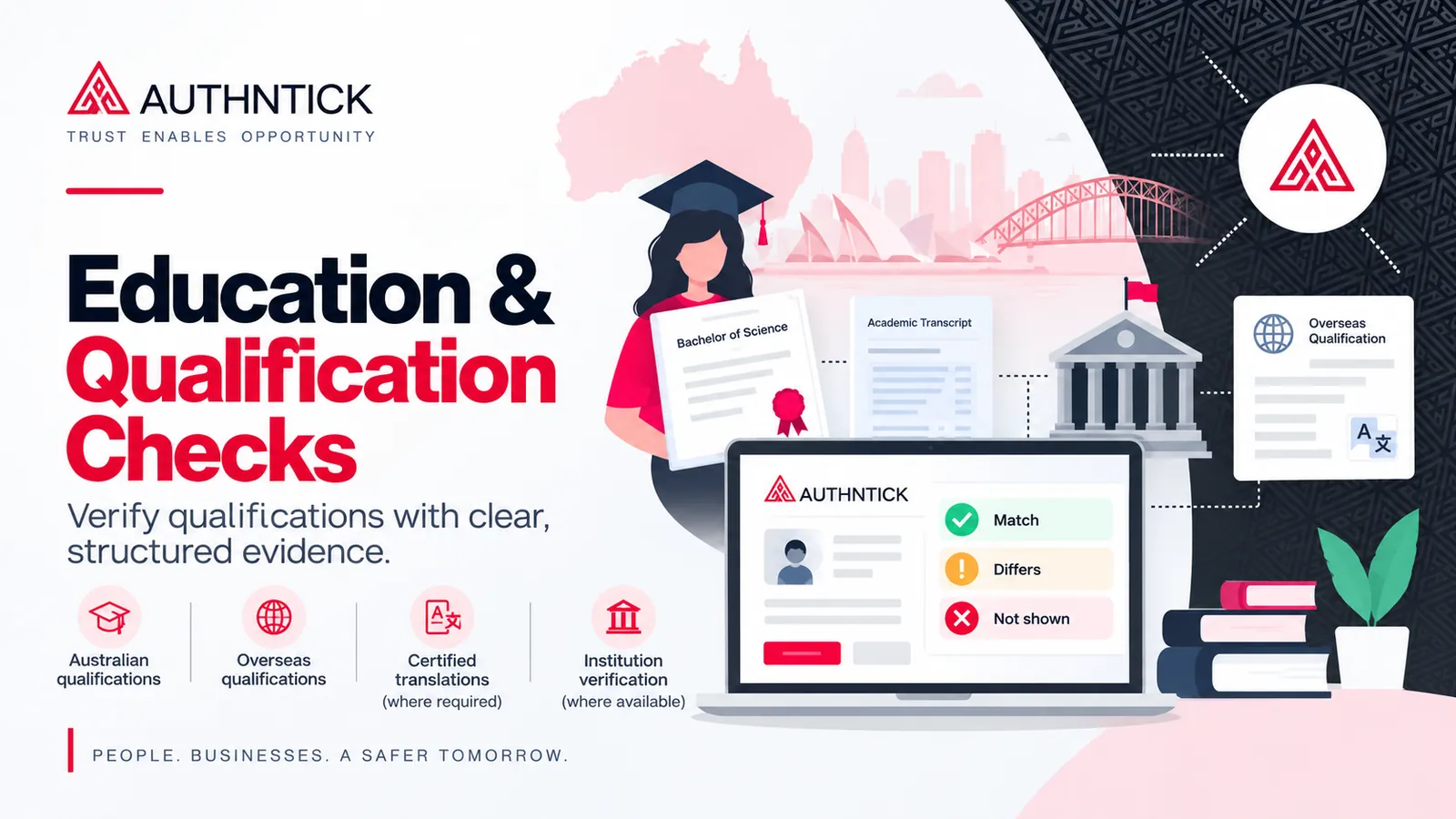
Education & Qualification Checks
Education & Qualification Checks are useful when an award or credential is material to the role. Candidates supply institution, country, qualification and completion details, then provide relevant academic evidence. The report compares available fields and identifies the evidence and verification method used.
Australian qualifications: candidates can share an official digital academic record through My eQuals where available, or upload a certificate or transcript. Available source information is compared with their claims. Document review, official digital records and independent institution verification are distinct methods; independent confirmation is only reported when actually performed.
Overseas qualifications: candidates provide the foreign institution and award details, academic documents and, where required, certified English translations. The workflow can also collect institution websites, registrar contacts, student identifiers and verification portal details. Coverage depends on the country, institution and available sources. A candidate-supplied link is not automatically a trusted source.
Results separate matches, differences and information unavailable for comparison. Checking an overseas qualification does not determine Australian equivalence, migration value or permission to practise. Those questions may require an appropriate assessing authority or professional registration process.
Professional Reference Checks
A Professional Reference Check gathers role-relevant feedback from nominated referees. Teams choose an AI-generated, pre-built or custom questionnaire; candidates provide consent and referee details, and referees receive digital invitations to respond.
The report distinguishes candidate-provided information from referee-provided information. Employment dates, role or title, relationship to the referee and other employment details can be compared to show where they align or differ. Structured feedback about responsibilities, performance and conduct remains available with the complete responses.
Referee statements and opinions are not automatically independently verified facts. Review discrepancies and feedback in context, alongside the factual Work History Check where relevant.
Address History / Address Verification
Address Verification helps compare or corroborate residential-history information where relevant to screening. Candidates enter their current and previous addresses and residence dates, account for missing periods, upload supporting evidence for each address and give their declaration and consent. The current workflow collects five years of history; that is not a universal legal requirement.
AuthNTick reviews names, addresses and supporting documents. The Address Check Result provides a history summary and an outcome for each address, including verified, partially verified, unable to verify or discrepancy identified, with review notes and limitations.
An address lookup can recognise an address but does not prove the candidate lives or lived there. Read each outcome against the evidence reviewed rather than assuming the entire residence history is established.
Bankruptcy Checks
AuthNTick currently lists Bankruptcy Checks as Coming soon; they are not yet available to order. Where financial-history screening is relevant to a role, confirm the appropriate scope and service availability before including it in your screening package.
Professional licences and other role requirements
A qualification is different from current registration or authority to practise. Where relevant, confirm the appropriate register, status, conditions and permitted scope of work. Additional statutory checks depend on the duties and jurisdiction; a general criminal-history check is not a substitute for every sector-specific clearance.
5. Review the evidence
Bring application evidence, assessment answers, interview records and verification results together for authorised human review. Candidate Comparison means comparing role-relevant evidence clearly, including gaps and limitations, rather than allowing an AI score to determine the “best” person.
- Check the source, date, purpose and scope of each result.
- Separate a confirmed difference from missing information or an unavailable response.
- Give the candidate an opportunity to clarify material discrepancies or disputed information.
- Assess relevant findings against the role’s requirements and document the organisation’s decision.
A criminal-history disclosure does not automatically determine suitability. Consider the applicable requirements and relevant circumstances. AuthNTick presents evidence and context; the organisation retains responsibility for employment decisions.
Choosing checks based on the role
These examples are illustrative, not a mandatory checklist or legal advice. Use the actual duties, relevant requirements and screening purpose to select checks.
| Role / requirement | Checks that may be relevant |
|---|---|
| Identity-sensitive responsibilities | Identity Verification against accepted document information. |
| Australian work entitlement | VEVO for visa holders where applicable; appropriate evidence for citizens. |
| Specified qualification | Education & Qualification Check; separate current registration review where needed. |
| Prior employment is material | Work History Check for factual claims and Reference Check for feedback. |
| Criminal-history screening requirement | The police-check type and purpose accepted by the requesting organisation. |
| Job-specific knowledge or judgement | Skills assessment and structured interview using relevant criteria. |
| Documented residential history requirement | Address Verification with supporting evidence and limitations. |
How AuthNTick simplifies pre-employment screening
The AuthNTick workforce screening platform connects candidate screening, assessments, interviews and verification so teams can manage relevant services within a shared process.
- One connected workflow: use the Business Portal to manage invitations, progress and completed screening records.
- Less manual administration: use assessment generation, reusable questionnaires and candidate-led data collection to reduce repetitive preparation and follow-up.
- Structured evidence: review claims, source responses, discrepancies and limitations in the relevant result format.
- Human review: give authorised hiring teams context and evidence while keeping decisions with the organisation.
- Candidate experience: provide a clear digital path for candidates to supply details, consent and complete the requested steps.
Candidate-specific invitations and configured general links can support different recruitment processes. For higher-volume workflows, HR-system integration options depend on technical scoping and account configuration. Confirm what is enabled before designing the process around it.
Plan information handling and review
Tell candidates what information is requested and why, restrict access to authorised reviewers and set retention and disposal rules. Avoid unnecessary local copies of sensitive documents. Consult the AuthNTick Privacy Policy and your organisation’s requirements when planning information handling.
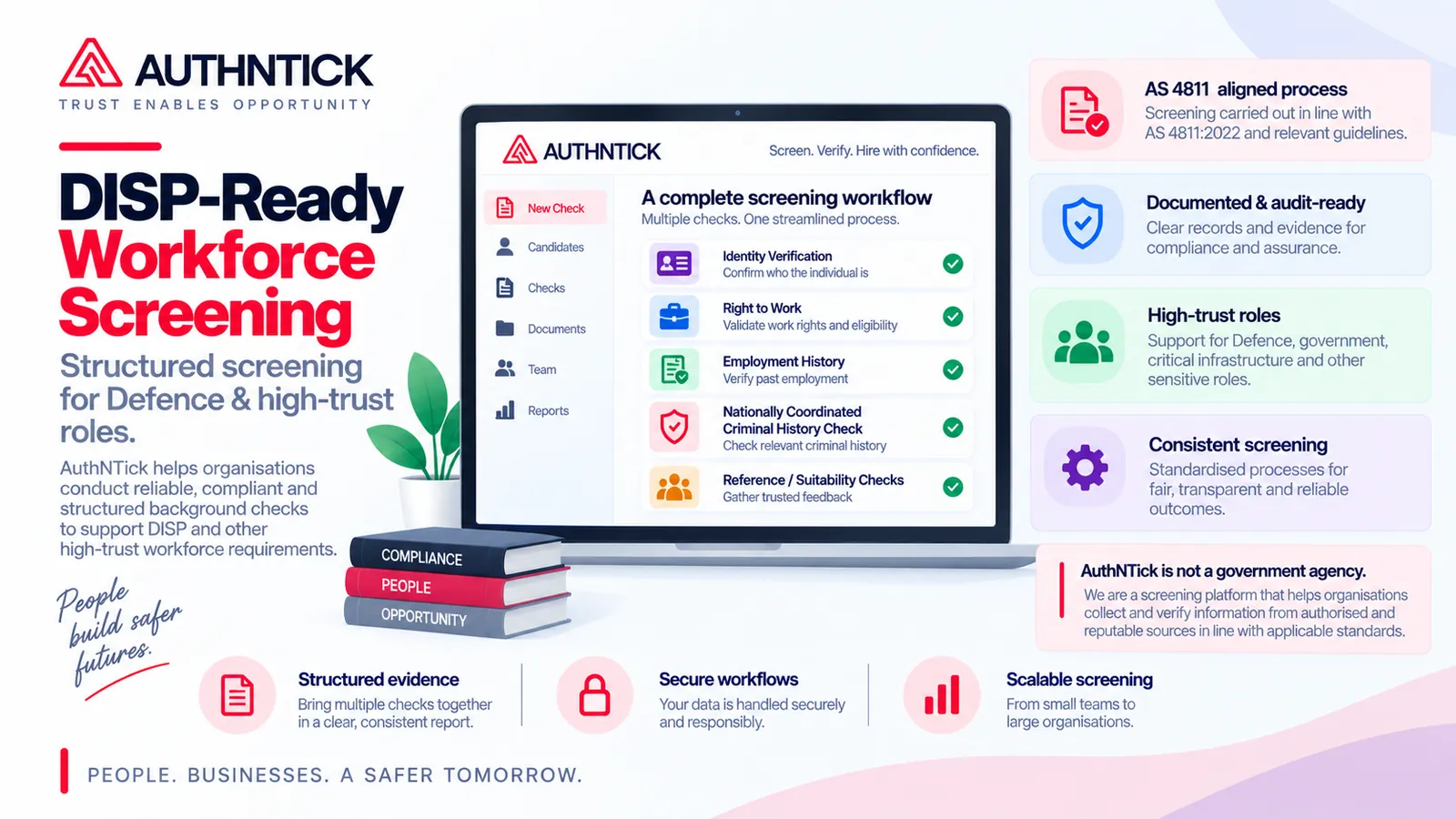
AuthNTick is a private provider, not a government agency. Screening tools support your organisation’s process; they do not establish that every obligation has been met.
Frequently asked questions
What is pre-employment screening?
Pre-employment screening brings together role-relevant information about a candidate before a hiring decision. It can include application screening, assessments, interviews and verification of candidate information. The employer decides which steps are appropriate and how to use the evidence.
What checks are included in pre-employment screening in Australia?
Depending on the role, checks may include identity, an applicable criminal-history check, VEVO work rights, work history, qualifications, references, address history and a proportionate social media review. Assessments and interviews add evidence about skills and judgement. Every candidate does not need every check.
How long does pre-employment screening take?
Timing depends on the selected services, candidate completion, document quality, employer or referee responses, institution availability and any police referral or manual review. Track each request separately and allow time for clarification. A delay is not evidence of an adverse result.
What is the difference between a criminal-history check and pre-employment screening?
A criminal-history check provides criminal-history information disclosed for its purpose at a point in time. Pre-employment screening is the broader process and may also cover work rights, qualifications, employment, references, assessments and interviews. A criminal-history check does not establish overall suitability for a role.
Can employers verify employment history?
Yes. With the appropriate consent and contact permissions, a Work History Check can compare candidate-provided employer, role, employment type and dates with an employer or authorised representative’s response. Records and disclosure policies may limit what can be confirmed.
Can employers verify qualifications?
Education checks can compare candidate information with academic documents, official digital records or an institution response where available. The report should identify the method actually used. Reviewing a supplied document is different from independent institution verification, and overseas verification does not itself establish Australian equivalence.
What is a VEVO work rights check?
A VEVO check reviews available visa and entitlement information with the visa holder’s consent. It may return visa status, class or subclass, work conditions and relevant expiry information. It is a point-in-time result, not a standalone identity check or a check of Australian citizenship.
How does identity verification work?
In AuthNTick’s current identity workflow, candidates consent, choose accepted documents and enter document-specific information. Relevant details are submitted for verification, responses are returned and the result is available for review. Two accepted documents must be successfully verified. A matching response is not a finding about trustworthiness or employment suitability.
Can AI be used for candidate screening?
AI can help organise CV information against role criteria, generate editable assessments and support structured interviews. Hiring teams should check the supporting evidence, limitations and relevance of the output, allow for clarification and retain responsibility for employment decisions.
What are pre-employment assessments?
Pre-employment assessments are structured questions or tasks exploring knowledge, skills or judgement relevant to a position. AuthNTick supports AI-generated assessments, templates and custom questions. Teams review the content and scoring before inviting candidates and consider results alongside other evidence.
How can employers make pre-employment screening more efficient?
Define the requirements for each role, choose relevant services, give candidates clear instructions and track outstanding requests centrally. AuthNTick connects screening, assessments, interviews and verification, reducing repeated administration while keeping evidence and final decisions available for human review.

About the author
Dev Tripathi
Editorial contributor and cybersecurity adviser
Dev Tripathi is a senior cybersecurity, risk and compliance professional with more than 20 years of experience. At AuthNTick, he contributes to and reviews guidance on Nationally Coordinated Criminal History Checks, identity verification, privacy, information security and workforce compliance.
Editorial references
Official and authoritative sources
Use these primary and authoritative references to confirm current requirements for the topic covered in this guide.
- Nationally Coordinated Criminal History Check validity Australian Criminal Intelligence Commission
- AFP Police Check Australian Federal Police
- Identity verification services IDMatch, Australian Government
- VEVO for organisations Department of Home Affairs
- Employment and privacy rights Office of the Australian Information Commissioner
- Guide to preventing discrimination in recruitment Australian Human Rights Commission
This guide is general information, not legal advice. Government processes and employer requirements can change, so check the linked source and the requesting organisation’s instructions before acting. Read our editorial and corrections policy.
Next step
Screen, assess, interview and verify in one connected platform.
Choose screening and assessment workflows appropriate to your roles. Bring the evidence together for your team’s review, with only the services you need.