A CV contains a lot of information: experience, qualifications, technical skills, certifications, previous employers, technologies, industries and responsibilities.
The challenge for hiring teams isn’t getting the information. It’s reviewing it consistently across dozens — or sometimes hundreds — of applications and understanding how each candidate’s experience relates to the actual requirements of the role.
That’s where AuthNTick CV Screening comes in. Instead of relying on keyword matching or asking AI whether someone is simply a “good candidate”, AuthNTick starts with a more useful question: What does this job actually require?
Hiring teams define the requirements of the role. AuthNTick then analyses candidate CVs against those criteria and surfaces the supporting evidence behind each result. The aim is to move from generic AI scores towards structured, reviewable evidence against the requirements of the role.
Start with the requirements of the role
Every role is different. Before screening candidates, hiring teams can define the criteria that matter for the position:
- Required experience
- Technical skills
- Qualifications
- Certifications
- Industry experience
- Leadership experience
- Specific technologies or platforms
- Other role-specific requirements
For example, a Senior Security Engineer position might require five years of relevant experience, Splunk experience and AWS security knowledge, while treating CISSP certification as preferred rather than required.
Each candidate CV can then be considered against the same defined criteria. This creates a structured starting point for reviewing applications rather than changing the screening approach from candidate to candidate.
AuthNTick · CV Screening
Sarah Chen
Senior Security Engineer
8 screening criteria · 4 shown in this example
| Screening criteria | Type | Result |
|---|---|---|
| 5+ years relevant experienceSelected criterion | Required | Meets |
| Splunk experience | Required | Meets |
| AWS security experience | Required | Partially meets |
| CISSP certification | Preferred | Not demonstrated |
5+ years relevant experience
Assessment
Relevant experience is demonstrated through multiple security engineering roles, including responsibility for enterprise SIEM operations.
Supporting résumé evidence
“Led SIEM operations using Splunk across enterprise security environments…”
Source: candidate résumé · Experience
Go beyond keyword matching
Finding a word on a CV doesn’t necessarily tell you whether a candidate has the experience you’re looking for. Imagine you’re hiring a cybersecurity engineer and require experience with Splunk. Simply finding “Splunk” somewhere on a CV provides limited information.
Was it a technology the candidate used every day? Did they administer it? Did they build detections with it? Was it part of a project? Or is it simply included in a long list of technologies?
AuthNTick is designed to identify relevant information within the CV and surface the context behind the requirement. The objective isn’t simply to find a keyword. It’s to show the evidence behind it.
Whether your team calls this CV screening or resume screening, the useful question is the same: what does the application tell us about this particular requirement?
See why a candidate matches a requirement
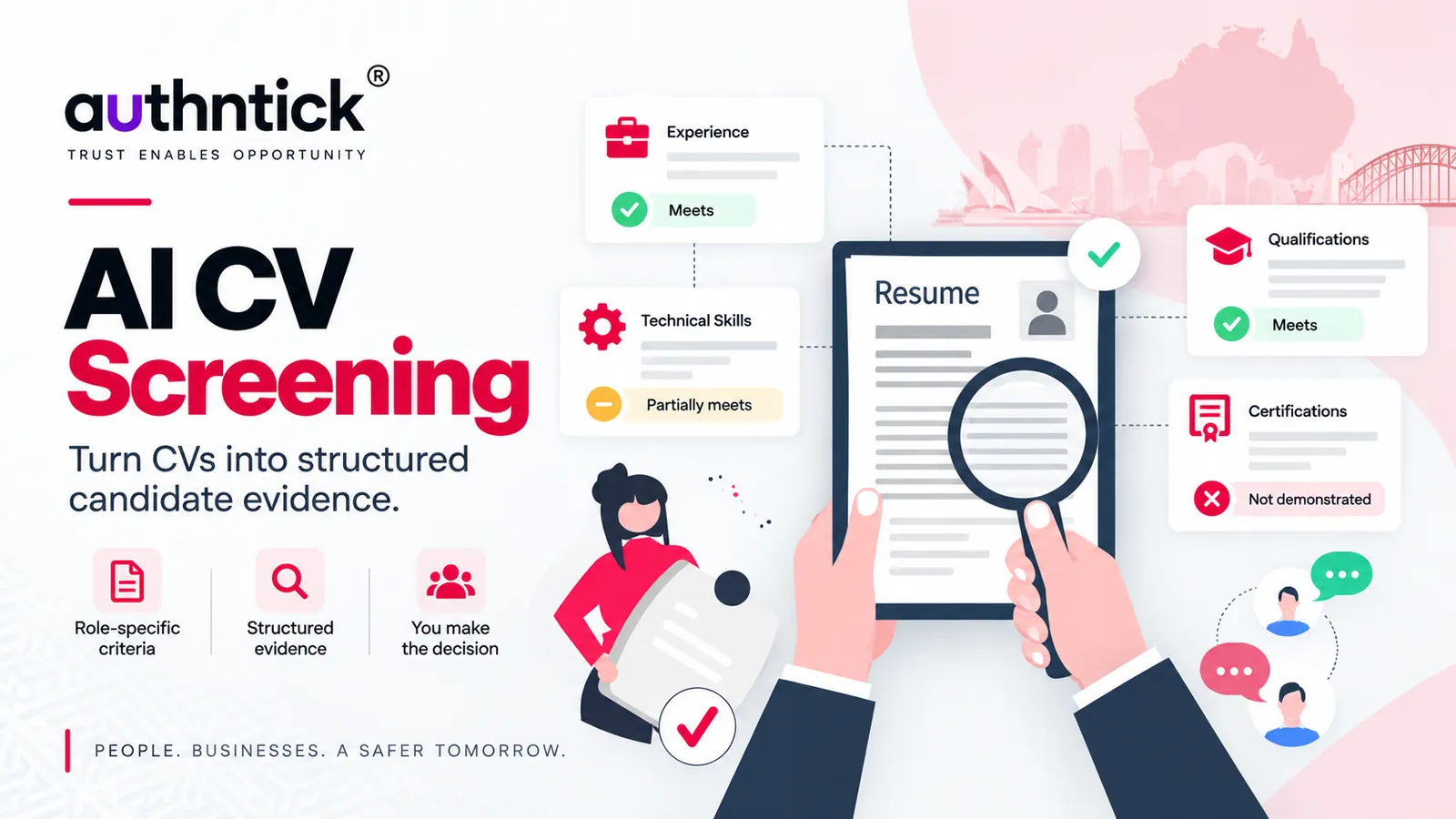
AI screening becomes more useful when hiring teams can understand the basis for an assessment. For each screening criterion, AuthNTick can indicate whether the information in the candidate’s CV:
- Meets — relevant evidence supporting the requirement is present.
- Partially meets — some relevant evidence is present, but the requirement is not fully demonstrated.
- Not demonstrated — the CV does not contain sufficient evidence to establish the requirement.
“Not demonstrated” describes the available evidence, not the candidate’s ability. Missing information may call for clarification or a follow-up assessment.
Hiring teams can review the supporting information themselves. Rather than relying only on an unexplained overall score, reviewers can see what evidence contributed to the assessment.
Screen candidates using the same framework
Manual CV screening can vary between reviewers. One recruiter might focus heavily on industry experience. Another might prioritise technical skills. Another might place greater emphasis on qualifications.
AuthNTick allows hiring teams to establish the screening criteria before applications are reviewed. Candidate CVs can then be analysed against the same role-specific requirements.
This gives hiring teams a more structured and reviewable first stage of the recruitment process while leaving people responsible for determining which candidates should progress.
From hundreds of CVs to candidates worth exploring further
High-volume recruitment creates a practical problem. A role might attract hundreds of applications, but hiring teams have limited time to understand every candidate in depth.
AuthNTick CV screening software helps organise the information contained within those applications around the requirements that matter for the role. Instead of repeatedly searching through CVs for individual requirements, hiring teams can review the relevant criteria, assessment and supporting evidence together.
The recruiter can then decide which applications warrant further consideration. Candidate screening software supports that review by making the relevant information easier to examine.
A CV is evidence — not the final answer
There is an important limitation to CV screening. A CV tells you what a candidate claims to have done. It doesn’t necessarily demonstrate what they can do.
That’s why we see CV Screening as the beginning of the assessment process rather than the end. A candidate might appear to have the required cybersecurity experience based on their CV.
The next stage could be asking them to demonstrate relevant knowledge through a Skills Assessment, and then exploring their experience and responses further through a structured AI Interview.
This creates a progression from claimed experience towards demonstrated capability and, where appropriate, verification.
Claim → Demonstrate → Verify
- 01 · Claim
CV Screening
What experience, qualifications and skills does the candidate’s application demonstrate?
↓ - 02 · Demonstrate
Skills Assessment + AI Interview
Can the candidate demonstrate relevant knowledge, judgement and capabilities?
↓ - 03 · Verify
References + Background Verification
Can relevant information and credentials be independently verified?
Move directly from CV screening to assessment
CV Screening is part of the broader AuthNTick platform. Once applications have been reviewed, candidates can move into the next appropriate stage:
- 01CV Screening→
- 02Skills Assessment→
- 03AI Interview→
- 04Reference Check→
- 05Background Verification→
- 06Hire
For example, a hiring team could screen applications against the requirements of the role, invite selected candidates to complete a role-specific Skills Assessment, conduct structured AI Interviews, and then complete reference and background checks where appropriate.
Instead of treating screening, assessment, interviewing and verification as completely separate processes, AuthNTick is designed to connect the evidence throughout the candidate journey. Choose the stages and order appropriate to the role.
Human decisions, structured evidence
AuthNTick CV Screening is designed to support hiring teams rather than make autonomous hiring decisions. AI can help extract, organise and present information contained in applications.
Authorised hiring teams remain responsible for reviewing that information and determining how it should influence the recruitment process. AI CV screening — also called AI resume screening — does not independently verify a candidate’s claims or determine who should be hired.
That’s why CV Screening focuses on showing the criterion, assessment and supporting evidence rather than simply providing an unexplained recommendation about whether somebody should be hired.
Introducing AuthNTick CV Screening
Define what matters for the role. Analyse candidate CVs against those requirements. Review the supporting evidence. Then move candidates into assessments, interviews and verification through the same platform.
Turn CVs into structured candidate evidence.

About the author
Dev Tripathi
Editorial contributor and cybersecurity adviser
Dev Tripathi is a senior cybersecurity, risk and compliance professional with more than 20 years of experience. At AuthNTick, he contributes to and reviews guidance on Nationally Coordinated Criminal History Checks, identity verification, privacy, information security and workforce compliance.
Editorial references
Official and authoritative sources
Use these primary and authoritative references to confirm current requirements for the topic covered in this guide.
- AuthNTick CV Screening AuthNTick
This guide is general information, not legal advice. Government processes and employer requirements can change, so check the linked source and the requesting organisation’s instructions before acting. Read our editorial and corrections policy.
Next step
Ready to move from research to action?
Use AuthNTick to complete secure Australian background checks, or speak with our team if you need the right workflow for your organisation.