A useful work history check should show what the candidate provided, what the employer was able to confirm, where information differs and what could not be independently verified. Hiring teams need evidence they can review, rather than an unexplained score or binary status.
AuthNTick provides work history verification with a clear evidence trail. Candidate-provided and verifier-provided information remain separate in a structured Work History Check Result, supporting the organisation’s own assessment and final decision.
- Employment history coverage and independent employment verification are different.
- Candidate consent and each employer’s contact permission form part of the workflow.
- A discrepancy or an inability to confirm a detail needs context; neither automatically establishes intentional misrepresentation.
What is a Work History Check?
A Work History Check is a factual comparison of employment or engagement information. The candidate supplies the claim; an employer or authorised representative responds using the information available to them. A reviewer can then see the source, response and limitations.
The AuthNTick Work History Check supports current and previous work, including contract and self-employed engagements. It records the original candidate information rather than replacing it when the source provides a different answer.
What information can be verified?
The factual questions cover the employment or engagement and its core details. Availability depends on the verifier’s authority, records and disclosure policy.
- Organisation / engagement: Whether the person worked for or provided services to the named organisation.
- Job title: The candidate’s role compared with the title the verifier can confirm.
- Employment type: Full-time, part-time, casual, fixed-term, contract, internship, self-employed or another described engagement.
- Employment dates: The start date and end date, or whether the person currently works for or provides services to the organisation.
For example, a payroll record may confirm dates but not a working job title. A former manager may know the role but no longer have access to the records. The result should retain that distinction instead of presenting every field as independently verified.
Work History Check vs Reference Check
| Work History Check | Reference Check |
|---|---|
| Compares factual organisation, role, employment type, dates and current status. | Can collect role-relevant referee feedback about responsibilities, performance, reliability, conduct and suitability. |
| Separates the candidate’s claim from the source’s confirmation or corrected value. | Records the referee’s perspective and feedback for the requesting organisation to consider. |
A Work History Check is not a character reference or performance review. If your screening scope needs qualitative feedback, consider a separate Reference Check. Education and Qualification Verification addresses a different claim: the candidate’s stated credential.
How an AuthNTick Work History Check works
- Candidate provides employment history. They record current and previous employers, roles, employment types and dates.
- Five-year coverage is calculated. Overlapping roles count once, with current work extending to the reference date.
- Periods outside employment are explained. Study, travel, unemployment and leave are recorded as candidate-provided context where needed.
- An appropriate verifier is nominated. The candidate supplies contact and relationship details, or indicates that contact information is unavailable.
- Consent and contact permissions are recorded. The candidate reviews their information and authorises the check, with a separate contact restriction for each employer.
- The employer receives a secure verification request. Invitations respect recorded contact permissions.
- The verifier reviews factual information. An authorised representative assesses the organisation, role, employment type and dates using available records.
- Responses are compared. The verifier can confirm, provide a different factual value or explain why information cannot be confirmed.
- Verifier declarations are captured. The verifier reviews their answers and declares their authority and the accuracy of the information.
- A structured result is produced. Following review, the Work History Check Result presents claims, source responses and limitations for the customer’s assessment.
The candidate has an opportunity to review and edit their information before final confirmation. The verifier also reviews their answers before submitting, with separate declarations that they are authorised to respond and that the information is true and accurate to the best of their knowledge.
Building a five-year work history
AuthNTick’s standard Work History Check helps candidates account for the previous five years. This is a history period, not a requirement for five continuous years of employment. Candidates begin with their current or most recent employer and add previous employment. Current work runs to the reference date; earlier employment is counted only where it falls inside the required window.
Overlapping periods count once. Adjacent calendar-day records are continuous: a job ending 30 June followed by another starting 1 July leaves no uncovered day. A job starting before the five-year window and continuing to the reference date covers the entire window, so the form does not ask about earlier history.
Your work history covers the required five-year period.
- Job title
- Systems Engineer
- Employment type
- Full-time
- Employment dates
- 1 Feb 2022 – Present
- Verifier
- Jordan Lee
- Relationship
- HR / People & Culture
- Verifier email
- jordan.lee@example.com
- When can we contact this employer?
- Now
Illustrative five-year window ending 19 September 2026. History coverage is separate from employment verification.
Five years is a product workflow, not a universal requirement attributed to AS 4811:2022. The appropriate period depends on the role, organisation, risk profile and screening policy. Define the scope before ordering and discuss additional requirements where needed; there is no universal three-, five- or seven-to-ten-year rule for every organisation.
A candidate who genuinely entered the workforce more recently can declare that they have provided all available work history. This exempts the period before their first employment. It does not remove a later unexplained period between jobs.
How employment gaps are handled
A period not covered by an employment record is not automatically an adverse finding. Study, travel, time not employed, parental or carer leave and other legitimate circumstances can explain a period.
The form identifies uncovered dates inside the required window and lets the candidate explain them. Candidate-provided explanations account for the history period and are recorded as context; they are not represented as independently verified employment.
Self-employment that can be checked can be recorded as an employment or engagement entry, with an appropriate verifier and supporting information. A reviewer should distinguish that factual verification from a candidate’s explanation of a period.
How employer verification works
The employer request presents the candidate’s information and asks an authorised representative factual questions. The wording includes people who worked for or provided services to the organisation, supporting contractors and other legitimate engagements as well as employees.
Use your organisation’s records where available.
- Candidate
- Alex Morgan
- Organisation
- Northstar Technologies Pty Ltd
- Role
- Systems Engineer
- Employment type
- Full-time
- Start date
- 1 February 2022
- End date / current
- Current
The verifier provides their name, role, relationship and contact details. A personal email address is accepted; an email domain alone does not establish or disprove authority. The declared relationship and source should still be assessed in context.
Did this person work for or provide services to your organisation?
When the verifier says the person did not work for or provide services to the organisation, a structured reason is recorded and the role/date questions are skipped. An inability to access records belongs under “Unable to confirm”, rather than an affirmative “No”.
Factual questions and corrected values
The verifier is asked “Is this job title correct?”, “Is this employment type correct?”, “Is this start date correct?” and “Is this end date or current status correct?”. Each can be answered Yes, No or Unable to confirm. No allows a corrected factual value; Unable to confirm records a reason such as unavailable historical records. This distinguishes missing evidence from a contradiction.
Consent and contact restrictions
Each employer has an independent contact permission: Now, Only after I give permission, or Only when authorised by the requesting organisation. Invitations and reminders respect the recorded restriction. Consent for the check does not erase an employer-specific contact restriction.
A candidate can indicate that contact details are unavailable. That permits supporting information and alternative verification review; it does not itself establish that the employment was verified.
Confirmed, different information provided, and unable to confirm
The review presents three distinct factual response states. These describe the source’s answer, rather than the organisation’s final employment decision.
| Response state | Meaning |
|---|---|
| Confirmed | The employer or authorised representative confirms the candidate-provided information. |
| Different information provided | The verifier supplies different factual information. Both versions remain visible for review. |
| Unable to confirm | The verifier cannot independently confirm the information, for example because records are unavailable or access is restricted. |
For “Unable to confirm”, the form records a reason such as unavailable records, employment predating available records or information held by another department. Only an “Other” reason requires an additional explanation. Optional factual notes can retain useful context.
What happens when the employer provides different information?
The verifier supplies the factual value they can confirm. For employment type, they can choose the same categories available to the candidate, including Other with a description. For an end date or current status that differs, they first state whether work is current and provide an end date if it is not.
Is this job title correct?
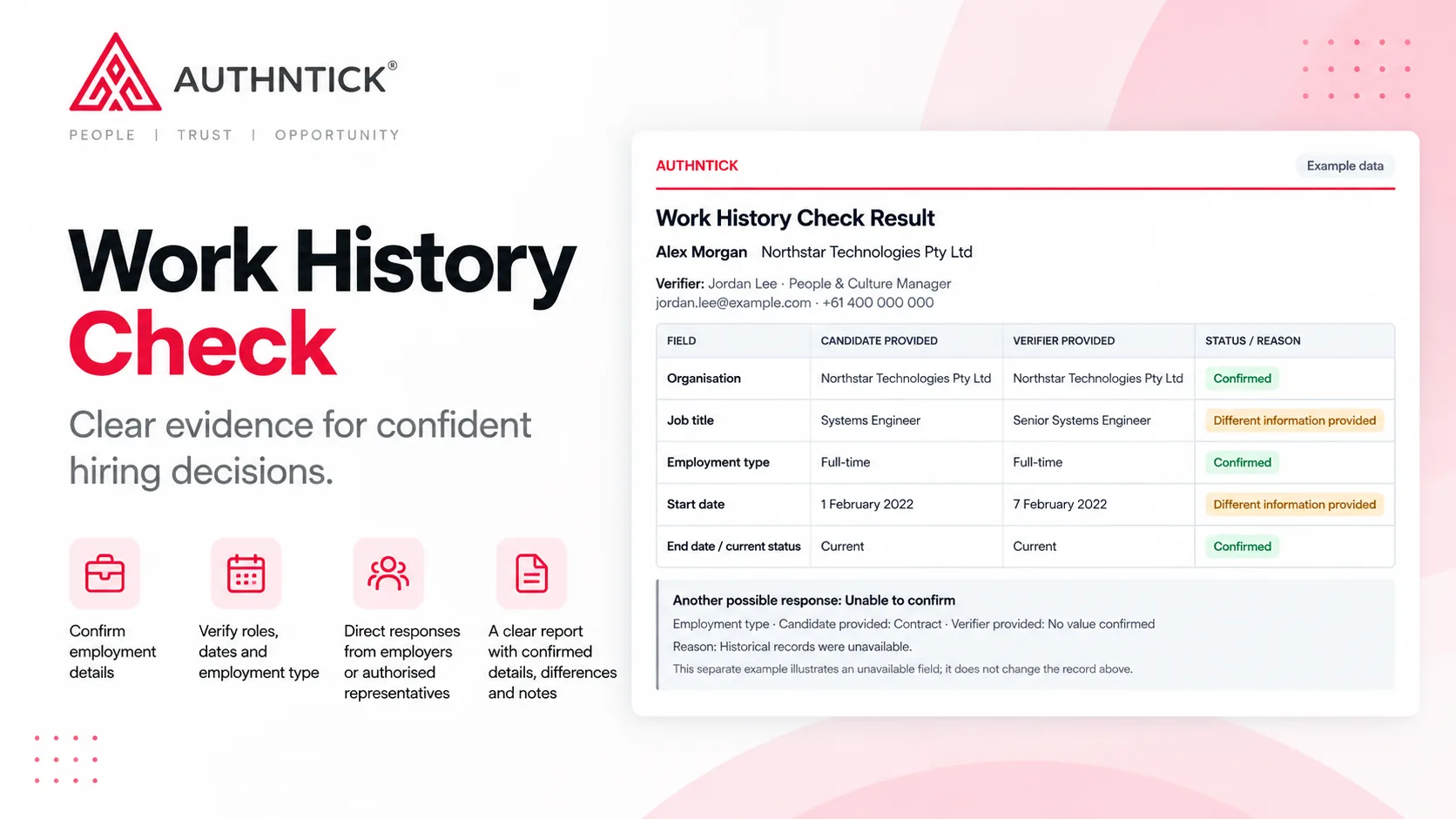
In the fictional example used throughout this guide, Alex Morgan provides Systems Engineer and a start date of 1 February 2022 at Northstar Technologies Pty Ltd. Jordan Lee, People & Culture Manager, supplies Senior Systems Engineer and 7 February 2022. AuthNTick preserves both versions as “Different information provided”.
Ordinary causes include a formal versus working title, payroll versus actual commencement dates, contract versus onboarding dates, entity or rebrand differences, and historical record limitations. A difference does not establish that the candidate lied. The customer can review whether a material difference needs clarification with the candidate.
Unable to confirm is not the same as a negative result
A verifier may be unable to access archived records, or an organisation may have closed, merged or been acquired. Records may sit with another department or legal entity, the verifier may lack access, or employer disclosure policy may limit the response. Historical information can also be unavailable.
The workflow retains the reason instead of automatically classifying the claim as false. A reviewer can consider other evidence and seek clarification. An unanswered or unavailable field is not automatically a mismatch or failed verification.
Can supporting documents be used?
Supporting documents can assist verification, particularly where employer records or contacts are unavailable. Examples include a payslip, employment contract, employment letter, separation certificate or statement of service.
Candidate-uploaded evidence does not automatically constitute independent verification. A useful result identifies the source relied upon, whether an employer response was received and what could not be confirmed. A closed business or inaccessible archive may leave direct verification unavailable even when documents provide context.
How work history verification fits into AS 4811:2022 workforce screening
AS 4811:2022 Workforce screening provides a framework for organisation-specific screening policies and processes. FMA’s public summary describes workforce screening as part of an organisation’s risk-management strategy and process.
AuthNTick’s Work History Check is designed to support risk-based workforce screening processes aligned with the principles of AS 4811:2022. The workflow records candidate consent, structured claims, authorised verifier responses, separate source values, discrepancies and limitations for review.
The organisation still needs to define the screening scope and apply its own policy to the role. Five years is the period used by this candidate workflow; it should not be interpreted as a requirement for every employer under the standard. This is not a claim of Standards Australia certification or endorsement, or a guarantee of legal compliance.
What does the AuthNTick Work History Check Result show?
The Work History Check Result presents the claim, source response and outcome separately. The current workflow preserves the candidate’s original values and the verifier’s corrections rather than silently overwriting the claim.
- Candidate details and recorded candidate consent.
- Employment verification summary and verification method.
- Candidate-provided organisation, role, employment type and dates.
- Verification source, verifier identity and declared relationship.
- Response for each assessed field and corrected value where applicable.
- Different-information and unable-to-confirm states, reasons and explanations.
- Supporting evidence, factual notes and relevant source limitations.
- Verifier declarations, submission information and review timestamp where recorded.
- The overall review outcome, separate from individual field responses.
A saved draft is not a received final response. Final submission confirms receipt of the verifier’s answers, not that every candidate claim was confirmed.
Verifier: Jordan Lee · People & Culture Manager
jordan.lee@example.com · +61 400 000 000
Evidence for review, not an automatic hiring decision
- Verification compares available factual employment information. Employer disclosure policies and record availability can limit which fields are confirmed.
- A difference does not by itself establish intentional misrepresentation. Payroll dates, contract dates, working titles, restructures and record retention can explain differences.
- Unable to confirm does not automatically mean a claim is incorrect. A missing response is also different from a verifier reporting contradictory information.
- Supporting documents can add context when direct employer verification is unavailable. Candidate-uploaded documents are not automatically independent verification.
- A Work History Check does not assess performance or character. Use a separate Reference Check for role-relevant referee feedback.
- AuthNTick presents evidence for authorised review. The requesting organisation remains responsible for the employment or engagement decision.
Give material differences an appropriate review, including relevant candidate clarification. Use the check alongside other role-appropriate screening information rather than as an automatic decision rule. Read the Work History Screening Services Terms for the service scope and limitations.
Frequently asked questions
What happens if I have worked for less than five years?
Provide your complete available history and declare that you have been in the workforce for less than five years. The period before your first employment is excluded; later gaps still need an explanation.
Is “Unable to confirm” a failed verification?
No. It records a limit on what the source can confirm, rather than a negative confirmation or an automatic fail. The reviewer considers the reason, available evidence and any clarification needed.
How does a Work History Check support AS 4811:2022 workforce screening?
It supports risk-based screening through defined factual questions, candidate consent, source attribution, recorded differences and reasons for unavailable information. Organisations determine the appropriate scope and retain the final decision. This is not a claim of certification.
What is a Work History Check?
It compares a candidate’s factual employment or engagement claims with information an employer or authorised representative can confirm, and records differences and limitations.
What information does AuthNTick verify?
The workflow asks about the organisation or engagement, job title, employment type, start date and end date or current status. Confirmation depends on the source and available records; every field is not guaranteed to be verified.
Does a Work History Check include a performance reference?
No. Work History checks factual employment information. A Reference Check can collect role-relevant feedback about responsibilities, performance, reliability, conduct and suitability.
How many years of work history does AuthNTick collect?
Five years is the period used by the current candidate workflow to track history coverage. The organisation should determine whether that scope is appropriate for its role, risks and screening policy.
Does AS 4811:2022 require exactly five years of work history?
AuthNTick’s five-year workflow should not be read as a universal requirement of AS 4811:2022. The standard provides a framework for organisation-specific screening policies and processes; the organisation determines its appropriate screening scope.
What happens if an employer provides different information?
The candidate’s original value remains separate from the verifier’s corrected value. An authorised reviewer can assess the difference, source and explanation in context.
What does “Unable to confirm” mean?
The verifier cannot confirm the detail from the records available. The response includes a reason, with an explanation required for Other. This is not automatically the same as an incorrect claim.
Can a candidate explain a gap in employment?
Yes. Candidates can record study, travel, time not employed, parental or carer leave, self-employment or another explanation. These explanations account for history and provide context; they are not independently verified employment.
Can supporting documents be used?
Yes. Payslips, employment contracts or letters, separation certificates and statements of service can assist review, including when employer contacts are unavailable. The result should identify the source relied upon.
Can a current employer be contacted without permission?
The workflow records a contact permission for each employer: Now, Only after I give permission, or Only when authorised by the requesting organisation. Automated invitations and reminders respect these restrictions.
Can contractors and self-employed work be included?
Yes. The candidate can describe contract or self-employed engagements and nominate an appropriate authorised representative, such as a client, accountant or business partner. The verifier is asked whether the person worked for or provided services to the organisation.
What happens if the previous employer no longer exists?
The candidate can indicate that contact details are unavailable and supply context or supporting evidence. Alternative verification can be reviewed, with its source and limitations recorded. Direct employer confirmation may remain unavailable.
Does AuthNTick decide whether a candidate should be hired?
No. AuthNTick presents screening information. The organisation decides how to interpret it against the role and its screening policy, and remains responsible for the hiring or engagement decision.
Plan a Work History Check for your organisation
Review the Work History Check workflow, or discuss the scope and verification needs of your roles.

About the author
Rahul Tripathi
Engineering and technology contributor
Rahul Tripathi is an engineer with interests in computer networks, digital systems and applied technology. At AuthNTick, he contributes to guides about digital identity, verification technology and practical screening workflows.
Editorial references
Official and authoritative sources
Use these primary and authoritative references to confirm current requirements for the topic covered in this guide.
- AS 4811:2022 Workforce screening Standards Australia
- Employment and privacy rights Office of the Australian Information Commissioner
- Guide to preventing discrimination in recruitment Australian Human Rights Commission
This guide is general information, not legal advice. Government processes and employer requirements can change, so check the linked source and the requesting organisation’s instructions before acting. Read our editorial and corrections policy.
Next step
Ready to move from research to action?
Use AuthNTick to complete secure Australian background checks, or speak with our team if you need the right workflow for your organisation.