Are Your Background Checks Delivering Real Results?
For Australian businesses, background screening is no longer just an administrative step. It is a critical part of hiring, compliance, and workforce risk management.
If your organisation is handling criminal history checks manually, relying on disconnected systems, or storing sensitive candidate information across multiple channels, it may be time to review whether your current process is delivering the security, compliance, and efficiency your team needs.
Ask yourself:
- Are you automating Nationally Coordinated Criminal History Checks, AFP Police Checks and identity verification efficiently?
- Can you track candidate status in real time?
- Can you request multiple checks instantly when needed?
- Are you managing everything through a secure and streamlined system?
Need a Better Background Check Process?
Simplify screening with a secure platform built for Australian businesses, government suppliers, and growing teams.
Is Your Hiring Process PSPF-Compliant?
Government agencies and security-conscious organisations are expected to align with the Protective Security Policy Framework (PSPF) by conducting rigorous pre-employment screening, including Nationally Coordinated Criminal History Checks and identity verification.
However, traditional screening processes often rely on manually collecting, storing, and sharing sensitive personal information. This can introduce avoidable security, privacy, and compliance risks if data is mishandled or exposed.
AuthNTick helps reduce these risks by providing a secure, compliant, and automated screening workflow that supports stronger governance and better operational control.
Why Choose AuthNTick for Your Nationally Coordinated Criminal History Checks?
In today's fast-paced hiring environment, waiting weeks for background checks is no longer an option. Whether you are an individual applying for a new dream job or a business managing high-volume recruitment, you need a screening partner that is fast, secure, and, most importantly - easy to use. For businesses managing hiring, onboarding, and compliance in Australia, reliable background screening is not optional. It helps protect staff, customers, organisational reputation, and regulatory standing.
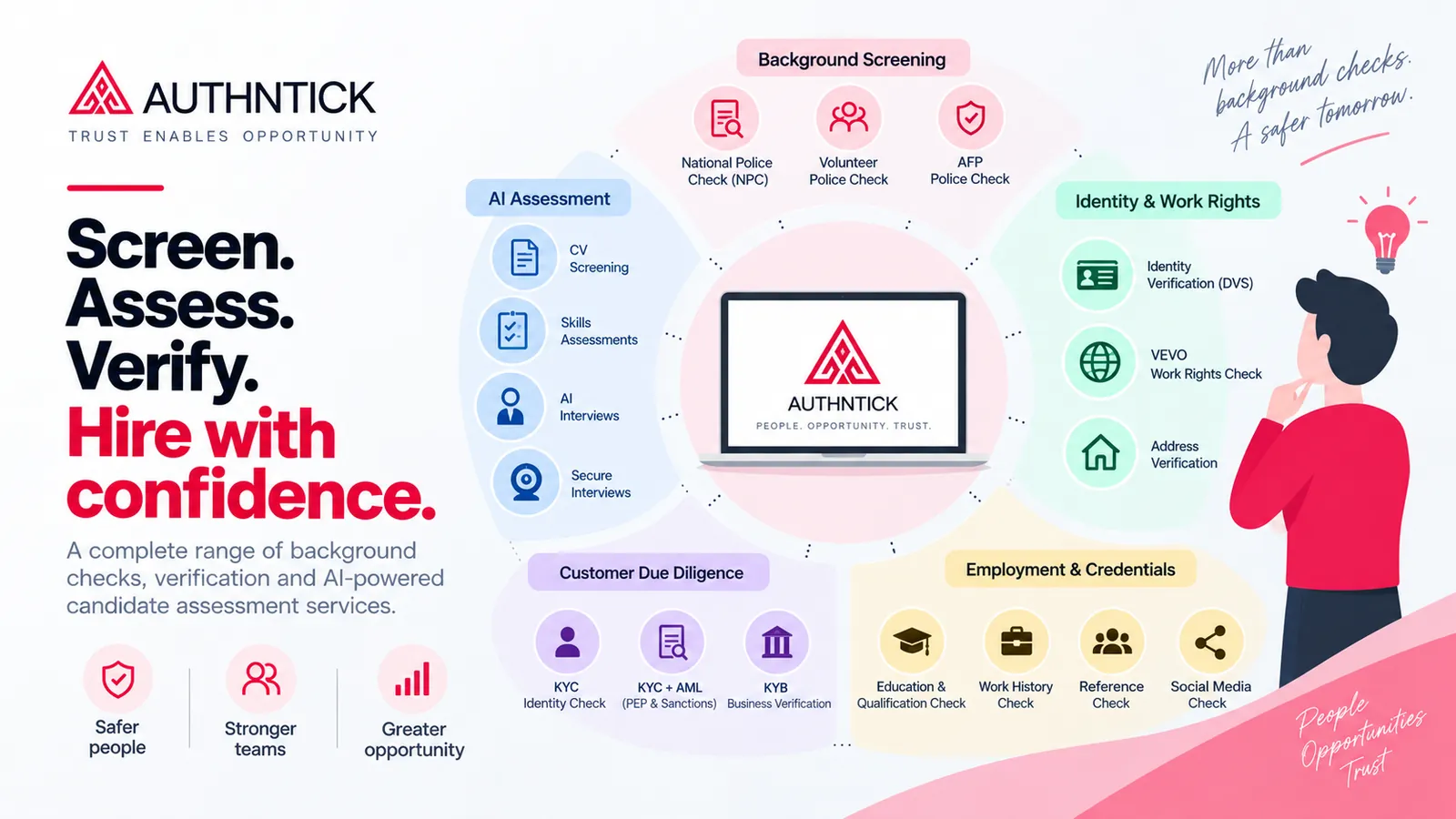
Outsourcing Nationally Coordinated Criminal History Checks, AFP Police Checks and identity verification to a specialist provider such as AuthNTick gives organisations access to stronger systems, greater consistency, and reduced administrative burden.
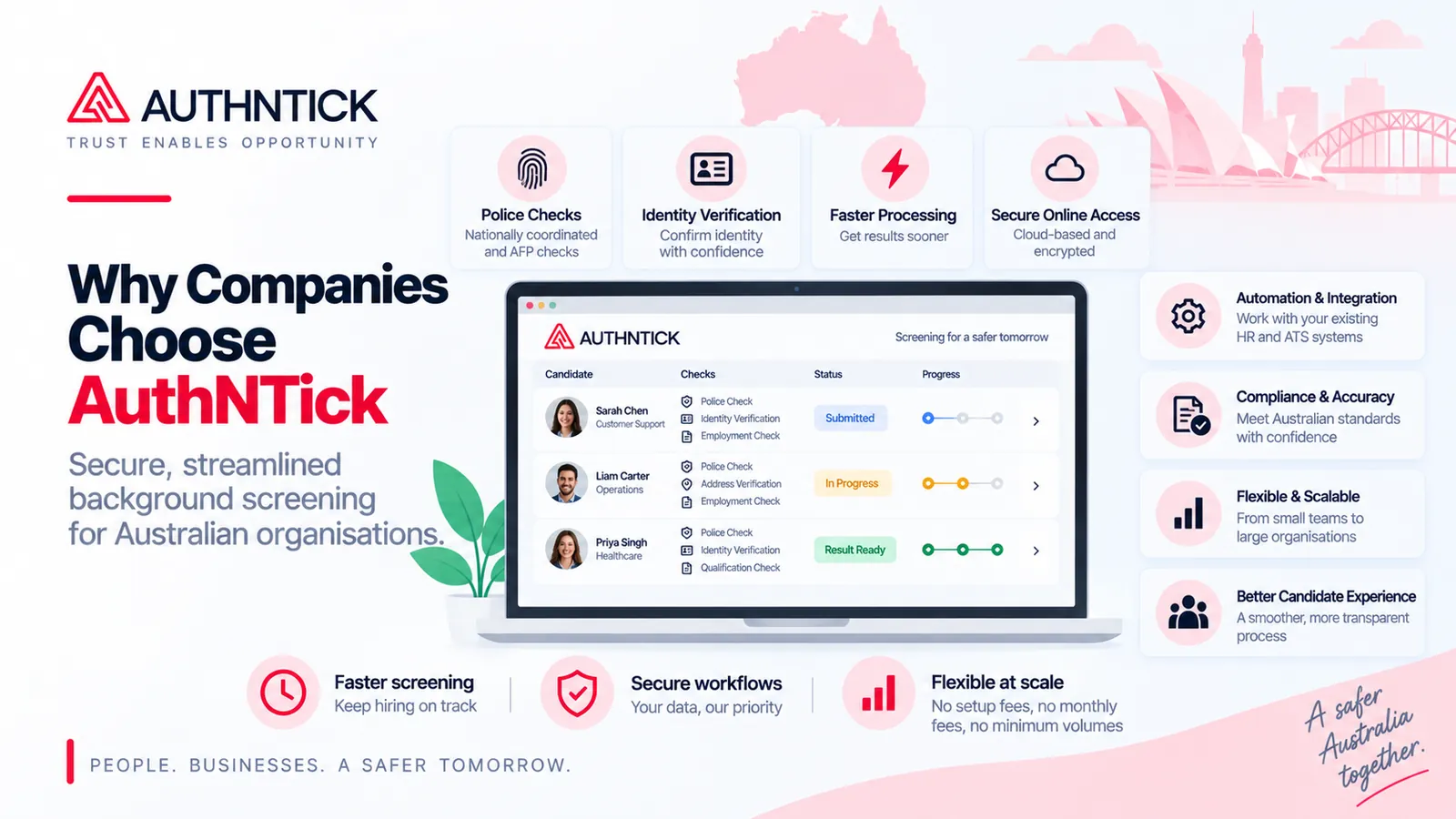
Many Australian businesses choose AuthNTick because our platform is designed to combine compliance, security, and speed in a way that supports both HR teams and candidates. At AuthNTick, we have reimagined the screening process to remove the traditional "red tape." Here is why thousands of Australians and leading HR departments choose us as their preferred accredited provider.
How AuthNTick Improves the Screening Experience
Zero Setup Fees & No Hidden Costs
Getting started with a professional background screening provider shouldn't cost you a cent. At AuthNTick, there are no setup fees to create your business account. Once you decide to partner with us, your account can be live and ready to process applications within one business day. We provide all the necessary digital paperwork to get you moving quickly.
No Monthly Fees or Minimum Volumes
We believe in flexibility, not contracts. Unlike many competitors, AuthNTick has no monthly maintenance fees and no minimum monthly volumes. Whether you need to run one check a year or one thousand checks a month, our system is here to serve your specific needs without the pressure of a subscription
Industry-Leading Turnaround Times
Time is your most valuable asset. Our automated system, combined with our expert compliance team, delivers results with some of the best turnaround times in Australia. 70% of our checks are completed within 24 hours, and many are returned in just minutes. We never trade quality for speed, ensuring every result is accurate and reliable.
100% Cloud-Based - No Software to Purchase
Our online screening system is entirely cloud-based. This means there is no expensive software to purchase, no equipment to install, and no complex programs to learn. You can access your HR dashboard from any device, anywhere. Plus, our dedicated account managers are available to provide training, making sure you get the most out of our simple-to-use platform.
Secure Online Access 24/7/365
Your hiring needs don't stop at 5:00 PM, and neither does our platform. You have the ability to enter information and utilize our automated features 24 hours a day, 365 days a year. While our local Australian support team is available during business hours to assist you, our secure portal remains open and fully functional around the clock.
Faster and More Efficient Processing
In a competitive hiring market, speed matters. AuthNTick helps employers move quickly with streamlined processes, reduced manual handling, and dependable turnaround times.
Better Candidate Experience
A simple and professional screening experience leaves a strong impression on candidates. AuthNTick provides clear instructions, a user-friendly application flow, and live support to help minimise friction and improve completion rates.
Technology Integration and Automation
AuthNTick supports modern hiring workflows through integration options, automation features, and real-time status visibility. This can reduce manual effort for HR teams while improving oversight.
Compliance and Accuracy
AuthNTick delivers compliant and reliable screening services designed to meet national requirements. This helps organisations maintain confidence in the checks they rely on.
Flexibility and Scalability
Whether your organisation is hiring one person or onboarding at scale, AuthNTick offers flexible delivery options to support bulk screening, seasonal demand, and growth.
Data Security and Privacy
AuthNTick aligns its operations with strict security and privacy expectations, including data sovereignty, residency, and protection of sensitive personal information.
Australian-Accredited Security
We take data security seriously. AuthNTick is officially accredited by the Australian Criminal Intelligence Commission (ACIC) and the Australian Federal Police (AFP). Our "Secure Candidate" process utilizes integrated biometrics and high-level encryption to ensure that sensitive personal data is protected at every stage of the screening process.
Our Services for Individuals and Companies
AuthNTick supports both individuals and organisations needing a Nationally Coordinated Criminal History Check for a wide range of purposes, including:
- Recruitment, job applications, and pre-employment screening
- Volunteer and not-for-profit roles
- Working with children or vulnerable people
- NDIS and worker screening-related roles
- Immigration and citizenship applications
- Visa applications
- Adoption-related applications
- Occupation-related licensing such as security, ASIC, and MSIC
- Licensing requirements including firearms licences
AuthNTick makes it easier for both individuals and businesses to access secure and compliant Nationally Coordinated Criminal History Checks nationwide.
Key Benefits of Using AuthNTick
- Speed and efficiency for faster hiring and onboarding
- Operational visibility through tracking and reporting tools
- Scalability for bulk checks and changing hiring volumes
- Compliance confidence for regulated and security-conscious organisations
- Better user experience for both HR teams and candidates
- Strong data security for sensitive personal information
- Cost-effectiveness for organisations managing ongoing screening needs
Reduce Compliance Risk and Make Better Hiring Decisions
Leaving background screening to specialists helps reduce the risk of regulatory issues, missed warning signs, and process inconsistency. AuthNTick provides objective, structured, and dependable screening support that helps businesses make informed hiring decisions.
By improving efficiency, strengthening compliance, and protecting sensitive information, organisations can build safer workplaces and more resilient hiring processes.
Outsource Your Background Checks With Confidence
Let AuthNTick help you streamline Nationally Coordinated Criminal History Checks, AFP Police Checks and identity verification through one secure system.
Ready to experience a faster way to screen?
Don't let slow background checks stall your progress. Join the businesses across Australia who trust AuthNTick for their compliance and safety needs. If your organisation wants a more secure, efficient, and compliant approach to background checks, speak with the AuthNTick team about the right solution for your hiring needs.

About the author
Rahul Tripathi
Engineering and technology contributor
Rahul Tripathi is an engineer with interests in computer networks, digital systems and applied technology. At AuthNTick, he contributes to guides about digital identity, verification technology and practical screening workflows.
Editorial references
Official and authoritative sources
Use these primary and authoritative references to confirm current requirements for the topic covered in this guide.
- AFP Police Check Australian Federal Police
- AFP Police Check 100 Point identification checklist Australian Federal Police
- AS 4811:2022 Workforce screening Standards Australia
- Employment and privacy rights Office of the Australian Information Commissioner
This guide is general information, not legal advice. Government processes and employer requirements can change, so check the linked source and the requesting organisation’s instructions before acting. Read our editorial and corrections policy.
Next step
Ready to move from research to action?
Use AuthNTick to complete secure Australian background checks, or speak with our team if you need the right workflow for your organisation.